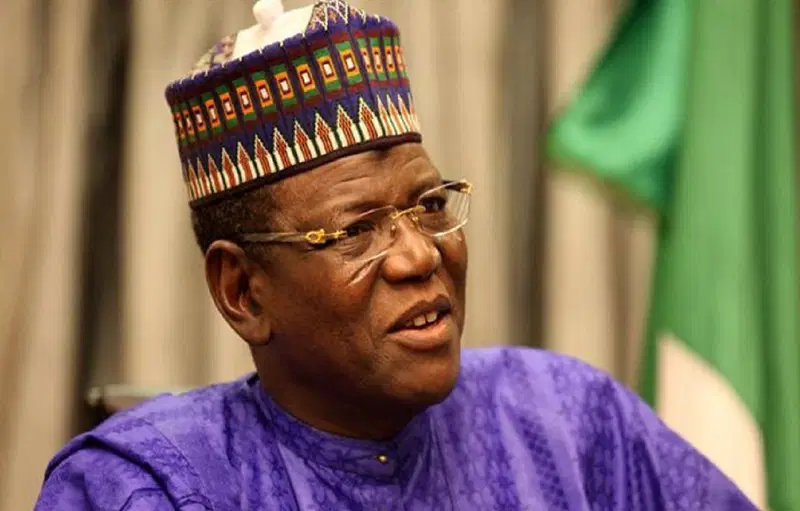
Former Governor of Jigawa State and one-time National Secretary of the defunct Social Democratic Party (SDP), Sule Lamido, has claimed that the annulment of the June 12, 1993 presidential election was motivated by a N45 billion debt allegedly owed to the late Chief Moshood Kashimawo Abiola by the Nigerian government.
Speaking in Abuja on Tuesday during the public presentation of his autobiography, Being True to Myself, Lamido alleged that the military government annulled the election which is widely regarded as the freest and fairest in Nigeria’s history, this is out of fear that Abiola, if sworn in as president, would demand repayment of the debt.
According to Lamido, the debt stemmed from contracts executed by Abiola’s company, International Telephone and Telecommunication, for the Ministry of Communications under the regime of the late General Murtala Mohammed.
“When General Murtala Mohammed died, Abiola came forward with a claim of about N45 billion for contracts executed. The military high command at the time refused to pay,” Lamido said. “Abiola even lobbied Northern Emirs to intervene, but the military still declined. When he won the 1993 election, they feared he would recover the money if inaugurated, which they believed could bankrupt the country.”
Lamido urged President Bola Tinubu to settle the alleged debt with the Abiola family, suggesting that doing so would bring closure to the June 12 saga. “He was doubly punished and denied both the presidency and his rightful dues,” Lamido stated.
He appealed to the Minister of Information and National Orientation, Mohammed Idris Malagi who represented President Tinubu at the event to relay the message to the President. “Tell the President to pay the N45 billion owed to the Abiola family. That will finally close the June 12 chapter,” he said.
Former President Olusegun Obasanjo, also present at the event, stressed that the mission of rebuilding Nigeria was ongoing. Addressing Lamido directly, he said, “You are now a statesman, but our job is not yet done. Nigeria still needs us.”
Obasanjo commended Lamido’s service during his tenure as Minister of Foreign Affairs, describing him as a loyal and effective diplomat who helped reintegrate Nigeria into the international community after years of isolation.
In his remarks, President Tinubu, through his representative, praised Lamido’s autobiography as a valuable addition to Nigeria’s political history and hailed Lamido as a principled opposition figure. He reaffirmed his administration’s openness to constructive criticism.
The president’s representative also spoke about the government’s economic reforms, acknowledging their current challenges but emphasizing that they are beginning to yield positive macroeconomic indicators. He reaffirmed the administration’s commitment to national security, inclusive development, and tax reform.
“Are we where we want to be? No. But President Bola Ahmed Tinubu has shown the audacity and vision required to set Nigeria on the path of growth and development. We are now entering a phase of beneficial outcomes,” he said.
Chairman of the occasion, former Head of State General Abdulsalami Abubakar, was represented by ex-INEC Chairman, Prof. Attahiru Jega. Jega urged more Nigerian leaders to document their experiences as a way of enriching the nation’s democratic and governance narratives.
“It is my hope that Being True to Myself will inspire other political actors and civil society leaders alike to write their own accounts. We all have a role in building a better Nigeria,” Jega said.
Lamido, in his vote of thanks, expressed appreciation to the organizing committee and dignitaries in attendance. The event attracted a notable array of political heavyweights, including:
Former Vice Presidents Atiku Abubakar and Namadi Sambo
Former Senate Presidents Ken Nnamani and Pius Ayim
Former Rivers State Governor, Rotimi Amaechi
2023 Labour Party presidential candidate, Peter Obi
Governors Muhammadu Yahaya (Gombe), Umar Namadi (Jigawa), and Caleb Mutfwang (Plateau)
Former governors Gabriel Suswam (Benue), Ahmed Makarfi (Kaduna), Babangida Aliyu (Niger), and Liyel Imoke (Cross River)
Advertisement