Nigeria has lost its long-held position as Africa’s largest importer of refined petroleum products, with South Africa now taking the lead, according to a new report by energy consultancy CITAC.
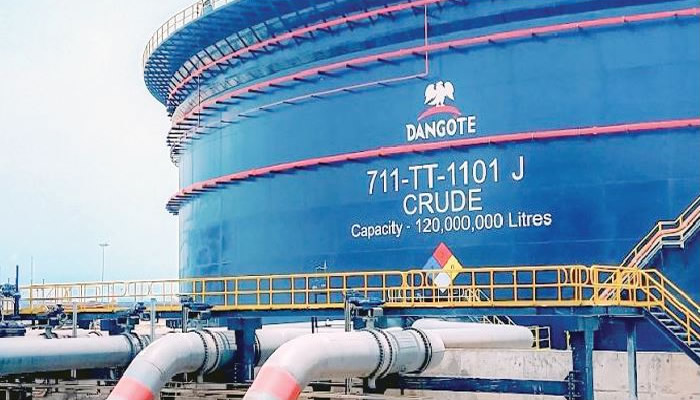
This shift comes on the heels of rising output from the Dangote Petrochemical Refinery, which began large-scale operations in early 2024. As the world’s largest single-train refinery with a capacity of 650,000 barrels per day, the facility is rapidly transforming Africa’s fuel landscape and significantly reducing Nigeria’s reliance on imported petroleum products.
CITAC’s latest data, released Wednesday, shows that Nigeria imported 3.1 million metric tonnes of refined petroleum products in the first quarter of 2025, compared to South Africa’s 4.2 million tonnes during the same period.
“The continued operation of the Dangote refinery is directly reducing Nigeria’s import volumes,” said CITAC Executive Director Elitsa Georgieva. She added that South Africa has consistently topped sub-Saharan fuel imports since the beginning of 2025.
Crude processing capacity across sub-Saharan Africa rose dramatically in 2024 which is up to 77.8% from the previous year, largely due to the Dangote refinery, which now processes around 550,000 barrels per day.
For Nigeria, the development marks a milestone. Despite being Africa’s top crude oil producer, the country has for decades relied on imported fuel due to inadequate domestic refining capacity. CITAC projects Nigeria’s total refined fuel imports in 2025 to fall to 6.4 million tonnes which is less than half of South Africa’s projected 15.5 million tonnes.
“The Nigerian market has undergone a major shift in product flows since mid-2023,” the report stated. “The Dangote refinery has displaced the bulk of international clean product imports into West Africa.”
While Nigeria’s dependence on imported fuel is decreasing, South Africa’s is growing. The country’s refining capacity has suffered setbacks due to industrial accidents, ageing infrastructure, and underinvestment, forcing the shutdown of several refineries since 2020. Transnet, South Africa’s state-owned logistics firm, reports that imported fuel now meets over 60% of the country’s demand.
The situation worsened in 2022 with the idling of Sapref—South Africa’s largest refinery, jointly owned by Shell and BP. Although the government acquired the plant in 2023, there is still no confirmed timeline for restarting operations. “South Africa’s mature infrastructure can’t mask its refining gaps, which are now being filled by foreign traders,” noted an executive involved in the Shell divestment talks.
The shift has important implications for Nigeria’s economy. Reduced fuel imports could strengthen the naira, ease pressure on foreign reserves, and narrow the trade deficit. It could also lower the government’s spending on fuel subsidies.
Meanwhile, the ripple effects are being felt across the oil trading industry. Swiss-based trader Mocoh announced a strategic overhaul in response to the Dangote refinery’s impact on West African fuel markets. Once heavily reliant on petrol deals with the Nigerian National Petroleum Company Limited (NNPC), Mocoh has pivoted after losing most of that business.
“In early 2025, we saw a paradigm shift,” said Olivier Lassagne, Mocoh’s CEO, in an interview with Platts. “We lost most of our petrol trade with NNPC, but that’s pushed us to adapt and grow beyond our traditional niche.”
Mocoh, a long-time player in Nigeria, is now working with Dangote to export surplus fuel to regional markets such as Benin, Cameroon, and Burkina Faso. However, competition remains stiff. Dangote has leaned toward large global traders like Vitol, BP, and Trafigura for major offtake agreements, while emerging firms like Atmin, backed by Afreximbank, are aiming to expand intra-African fuel flows.
“Dangote values flexibility and market-based pricing,” said Lassagne. “They’re not locking themselves into exclusive deals, which opens up opportunities for agile players like us.”
Advertisement