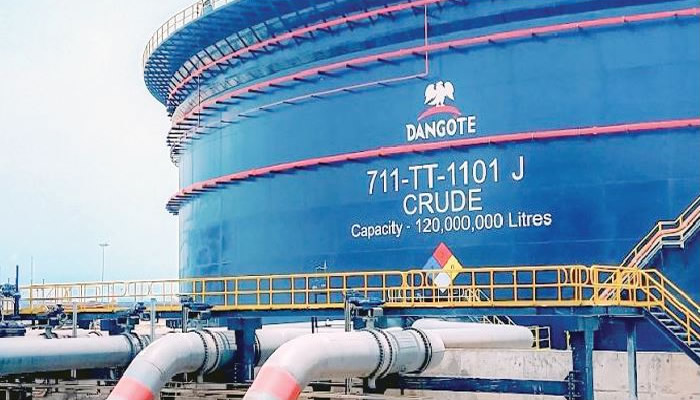

Aliko Dangote, President of the Dangote Group, has revealed that his $20 billion refinery is increasingly sourcing crude oil from the United States due to persistent shortfalls in local supply.
Despite the Federal Government’s crude-for-naira policy aimed at stabilizing fuel prices and easing forex pressure, the Dangote Petroleum Refinery has struggled to secure adequate feedstock domestically.
During a visit by the One-Stop Shop Technical Committee, Dangote disclosed that the facility has already received 3.65 million barrels of imported crude and expects to import a further 17.65 million barrels between April and July 2025.
Bloomberg tracking data indicates that US WTI Midland now accounts for about one-third of the refinery’s crude imports. The refinery, designed to process up to 650,000 barrels per day, is prioritizing supply reliability as it scales operations.
Dangote commended the naira-for-crude initiative but noted that the refinery’s shift toward US imports is a practical response to irregular Nigerian supply. Previously, the facility sourced crude from Brazil, Angola, and Libya, but has turned to US grades for their consistent quality, better refining yields, and pricing advantages.
Between April 6 and May 28, 2025, 21 vessels delivered over 3.6 million barrels of crude via Lagos ports, with an additional 14 million barrels expected by the end of July, according to maritime tracking firm Blue Sea Maritime.
Energy analysts from Rystad Energy and Energy Aspects report that WTI crude aligns well with the refinery’s technical specifications, offering higher output and operational efficiency compared to Nigerian grades like Bonny Light, which are hampered by infrastructure and pricing issues.
Committee Coordinator Maureen Ogbonna praised the refinery as a cornerstone of President Bola Tinubu’s push for energy self-sufficiency, saying it impacts nearly every sector of the Nigerian economy.
Despite current challenges, Dangote Group reaffirmed its commitment to meeting domestic fuel demand and producing surplus for export.
A recent company statement confirmed plans to maintain stable petrol prices, crediting the crude-for-naira policy, which resumed in full after a six-month pilot ended in March.
Advertisement