The Olowu of Kuta, Oba Adekunle Oyelude, has called on authorities responsible for appointment of traditional rulers to identify and address what he described as “cultural misfits” within the royal institution and individuals who, he said, fail to uphold the culture and traditions of their people.
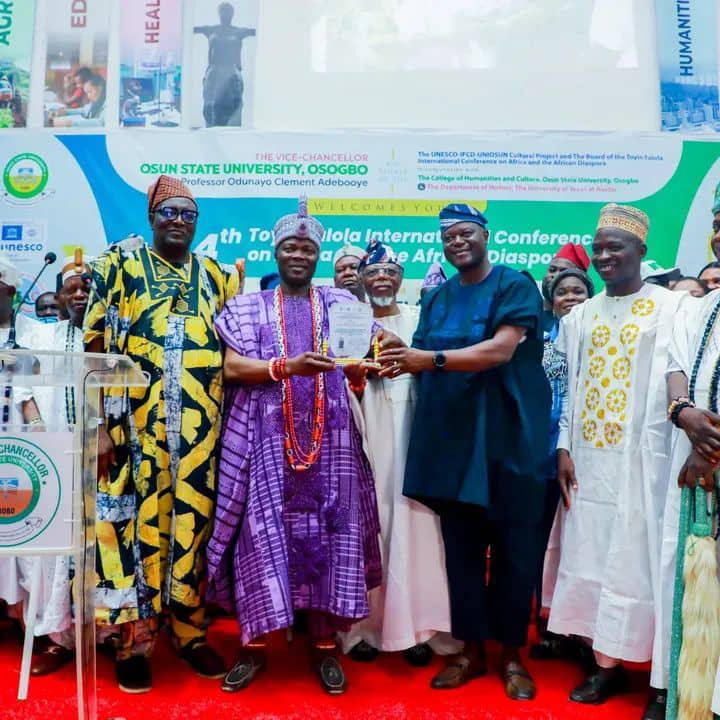
Speaking after receiving UNESCO-TOFAC Royal Cultural
Ambassador award at the 14th Toyin Falola International Conference on Africa and African Diaspora held at the Osun State University, Osogbo on Tuesday.
The award was in recognition of Oba Oyelude’s efforts to promote Yoruba culture and tradition.
Speaking with newsmen, Oba Oyelude said, “Within the traditional institution, don’t shy away. Some of us (traditional rulers) thought we could be on the throne and change the goal post halfway,” he said.
“No, we are installed culturally and we don’t have any role articulated by the Chieftaincy Law other than being traditional rulers for the maintenance of tradition and culture. We have a substantial amount of cultural misfits among us. Please help us to fish them out and correct them because of posterity,” he added.
Oba Oyelude also urged scholars and public intellectuals to help reshape Nigeria’s global image by sharing positive narratives.
“In the past, the late M.K.O. Abiola started the project called reparation and we have seen the fruits of his efforts today. Many of the artifacts and the bronze are being brought back,” he said.
“This project of UNESCO partnering with the University of Texas in Austin and Osun State University (UNIOSUN) is not a small feat. It is something to reckon with when we use culture to reshape our image worldwide.”
Oba Oyelude was honoured alongside other monarchs: the Eburu of Iba, Oba Adekunle Adeogun-Okunoye; the Aragbiji of Iragbiji, Oba Abdulrosheed Olabomi; and the Orangun of Oke-Ila, Oba Adedokun Abolarin.
In his keynote address titled Culture Matters, renowned historian Professor Toyin Falola reflected on the lasting impact of colonialism on African identity.
“Throughout history, colonisers did not just take the African land. They tried to erase the African culture,” he said.
“They changed African names, outlawed African languages, made a mockery of African religions, and imposed foreign systems. They did all of these because they understood that to capture a people, you must destroy their culture.”
Falola emphasized that cultural preservation is both a political act and a survival strategy.
“To lose culture is to lose a part of ourselves. But to protect culture, to invest in it, to learn from it and to pass it on is an act of survival. It is resistance.”
He also warned that development efforts often fail when they ignore the cultural context of the people they intend to serve.
Hon. Abiodun Bankole Ojo, Osun State Commissioner for Culture and Tourism, emphasized the government’s commitment to developing cultural sites despite financial constraints. “We are doing our best. Though it’s not easy, we need partnerships to drive culture and tourism development. It’s a function of funding,” he said during an interview.
He also revealed plans to upgrade infrastructure to enhance accessibility and security, creating an environment that underscores the value of cultural tourism. “We are working on roads, security measures, and preparations for key events like the Sango Festival in Ede and the development of the Olumirin Waterfalls,” he added.
Highlighting the economic potential of culture, he noted, “Culture can attract investors from the diaspora. We are taking it to another level, it has become central to our developmental agenda.”
In his remarks, the Vice Chancellor of Osun State University, Prof. Clement Adebooye, lauded the collaborative efforts of the Toyin Falola International Conference Board, UNESCO-IFCD-UNIOSUN Cultural Project, the UNIOSUN College of Humanities and Culture, and the Department of History at the University of Texas, Auston.
Describing the conference as historic, Adebooye noted that UNIOSUN was the first Nigerian university to secure a UNESCO Research Grant on culture. He added that the university was committed to strengthening its cultural research output and academic capacity.
Mr. Bolaji Amusan, popularly known as “Latin” and President of the Theatre Arts and Motion Pictures Practitioners Association of Nigeria (TAMPAN), also addressed the audience, stressing the importance of preserving indigenous identity. “Our tribal marks and local tattoos, once worn proudly by our mothers and ancestors, are significant and should not be forgotten,” he said.
The Toyin Falola Conference, named after the renowned Nigerian historian and professor, continues to serve as a crucial platform for dialogue on African cultural identity and innovation, bridging voices from the continent and the diaspora.
Advertisement