
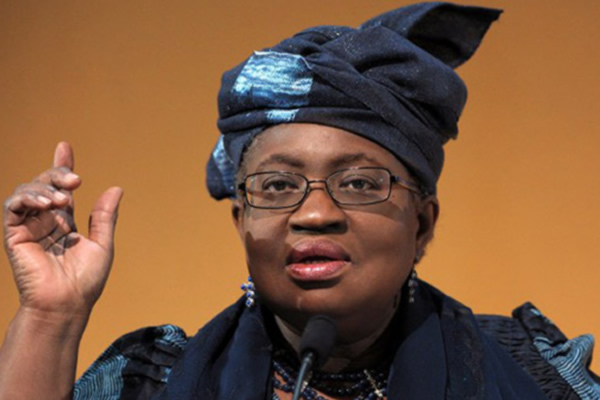
World Trade Organisation (WTO) Director-General, Ngozi Okonjo-Iweala, has launched a $50 million global fund to support women entrepreneurs in digital trade, warning that rising protectionism and unilateralism are threatening global commerce.
The Women Exporters in the Digital Economy (WEIDE) Fund, jointly run by the WTO and the International Trade Centre, aims to equip women-owned businesses in developing countries with skills, resources, and networks to compete in global value chains.
Speaking in Abuja on Thursday, Okonjo-Iweala cautioned that Nigeria’s low internet penetration with only 45% of the population connected compared to the global average of 67% could hinder the country’s participation in the fast-growing digital trade sector.
She stressed that steady electricity and affordable, reliable internet were vital for full digital integration.
She highlighted that while global trade is worth $30.4 trillion, Africa’s share of digital trade remains below 1%, even though the sector has quadrupled in value from $1 trillion in 2005 to $4.25 trillion today.
Nigeria was selected as one of only four pilot countries alongside Jordan, Mongolia, and the Dominican Republic after a highly competitive process involving over 600 business support organisations.
Out of 67,000 Nigerian applicants, 146 women entrepreneurs were chosen. Sixteen “Booster Track” awardees will each receive up to $30,000 and 18 months of technical support, while 130 “Discovery Track” beneficiaries will get up to $5,000 and one year of business assistance.
The recipients operate across diverse sectors, including agriculture, fashion, IT, hospitality, beauty, and manufacturing.
Okonjo-Iweala praised Nigeria’s \$2 billion fibre optic project but stressed that digital trade cannot flourish without reliable electricity. She also noted that women remain underrepresented in Nigeria’s ICT sector, owning only 30% of tech firms despite the industry’s rising contribution to GDP.
She urged policymakers to view women’s empowerment as an economic strategy, warning against policies such as customs duties on cross-border digital trade, which could harm small exporters.
Addressing the beneficiaries, she encouraged them to scale their businesses, create jobs, and inspire others, emphasising that women’s success drives community and economic growth.
Advertisement