
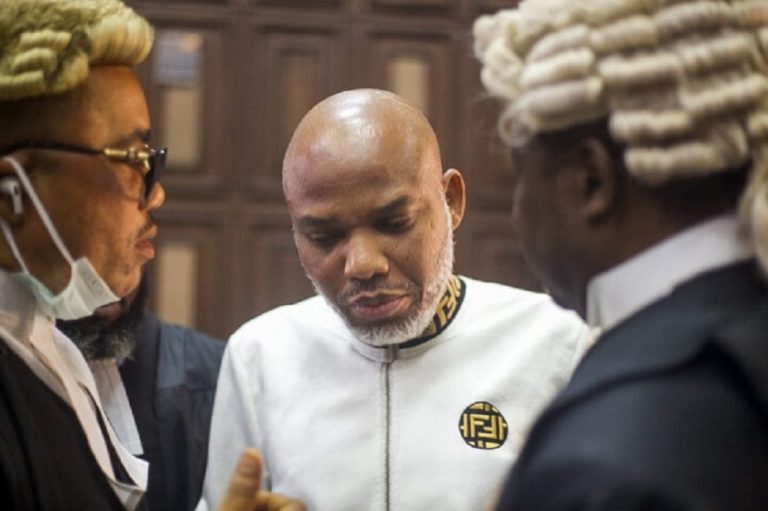
The Abuja Division of the Court of Appeal on Friday dismissed the appeal filed by Nnamdi Kanu, the convicted leader of the Indigenous People of Biafra.
Kanu had approached the appellate court over what he described as violations of his fundamental rights by the Director-General of the Department of State Services and the Attorney-General of the Federation.
However, the three-man panel ruled that the appeal was without merit and had become academic, given Kanu’s conviction and life sentence handed down by the Federal High Court in Abuja on November 20.
Delivering the lead judgment, Justice Boloukuromo Ugo said the alleged violations—including denial of adequate medical treatment, dignity of person, and freedom of religion—could not be considered anymore since Kanu was no longer in the custody of the DSS but in a correctional centre.
Justice Ugo also pointed out that Kanu’s counsel, Maxwell Opara, had confirmed at the beginning of the hearing that his client was being held at the Sokoto Correctional Centre, making the request for his transfer from DSS custody to Kuje prison irrelevant.
He added that Kanu had previously stated a preference for prison custody, and as a result, the reliefs sought had been overtaken by events following his conviction and lawful remand.
The appeal sought to overturn the July 3 ruling of retired Justice Taiwo Taiwo of the Federal High Court, who had dismissed Kanu’s fundamental rights enforcement application for lack of proof.
The respondents in the matter were the DSS Director-General, the DSS, and the Attorney-General of the Federation.
In the original suit filed in December 2021, with suit number FHC/ABJ/CS/1585/2021, Kanu alleged worsening health conditions while detained by the DSS and claimed that the medical personnel attending to him were unqualified.
But DSS lawyer, Idowu Awo, countered that Opara did not provide evidence to show that the medical personnel were “quacks.”
The AGF’s lawyer, Simon Enoch, equally urged the court to reject the application.
In its judgment, the Federal High Court held that Kanu failed to present convincing evidence of torture, denial of religious rights, or inadequate medical care.
Justice Taiwo ruled that although detainees have the right to practise their religion, such practice must not interfere with the rights or peace of others in custody.
Regarding the allegation of poor medical care, the judge observed that the applicant did not call any medical expert to support his claims.
The High Court therefore dismissed the suit for lacking merit—a decision now affirmed by the Court of Appeal.
Advertisement