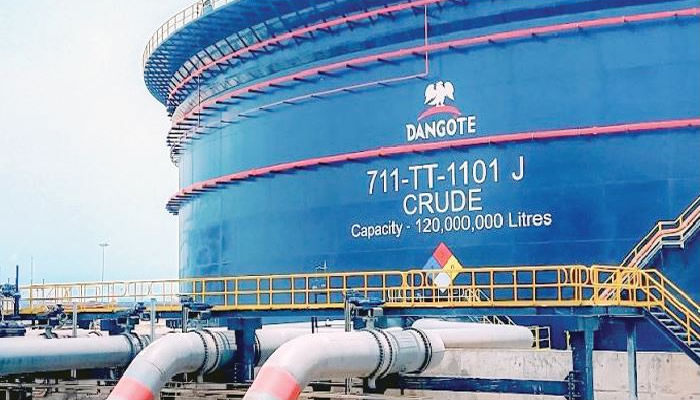
The Dangote Refinery is helping Nigeria conserve more than ₦10 billion annually in foreign exchange by cutting down fuel imports, according to Sunday Esan, Senior General Manager, Corporate Communications at Dangote Industries Ltd.
Esan made this known in Lagos on Thursday during the 2025 Media Week organised by the Nigeria Union of Journalists (NUJ), Lagos Council. The event focused on “Unlocking Opportunities for Businesses in a Challenging Economy: The Role of the Media / Roadmaps to Energy Security in Nigeria.”
He described the refinery as more than just a major national project, noting that it is boosting GDP growth, creating jobs, strengthening Nigeria’s energy supply, and positioning the country as a key energy player in Africa.
Esan said the refinery, which began operations almost two years ago, has sharply reduced Nigeria’s dependence on imported petroleum products. This impact, he explained, can already be seen in reduced PMS and diesel imports, improved stability of the naira, and thousands of new jobs created across the energy value chain.
Citing official figures, he noted that fuel imports dropped by 1.54% in the first quarter of 2025.
“Nigeria spent $2.6 billion on fuel imports in Q1 2024. By Q1 2025, that figure had fallen to $1.2 billion,” he said.
“Dangote Refinery has saved the country over ₦10 billion in forex annually by replacing imports with local production.”
He added that the refinery has made a “measurable economic impact,” significantly shrinking oil import volumes while improving national energy security.
Esan also revealed that plans are underway to scale up the refinery’s capacity from 650,000 barrels per day to 1.4 million barrels per day. Interest from global buyers is growing, with Saudi Aramco and U.S. companies reportedly seeking access to the refinery’s jet fuel.
He described the refinery site as “massive,” covering an area about seven times the size of Victoria Island in Lagos, a space so large that a full tour by car takes roughly five hours.
Esan disclosed that the acquisition of 4,000 CNG-powered trucks for distribution has already created about 24,000 jobs nationwide.
“This shows the scale of the investment one man, Alhaji Aliko Dangote, has brought into reality,” he added.
Speaking further, Esan appealed to journalists, especially members of the NUJ, to ensure accurate reporting on developments in the energy sector. He encouraged media professionals to visit the refinery for firsthand knowledge.
“When some people attempt to discredit the project, you will understand why this is a national asset that deserves protection,” he said.
NUJ Lagos Chairman, Adeleye Ajayi, described the lecture as an important opportunity to examine Nigeria’s energy challenges and recognised the Federal Government’s efforts to strengthen the sector.
He reaffirmed the media’s responsibility in shaping public discourse and urged the Dangote Group and other energy players to continue working closely with journalists.
Chairman of the Press Week Committee, Wale Akodu, also reflected on the days of fuel scarcity and panic buying, noting that such crises have reduced significantly with improved local refining capacity.
Advertisement