On Thursday, Guinea-Bissau’s military appointed General Horta N’Tam to lead the country for one year, a day after detaining President Umaro Sissoco Embaló and halting the release of election results.
Soldiers patrolled the area around the presidential palace in Bissau on Thursday morning, while a few residents walked along the main road near the building, where heavy gunfire had erupted the previous day.
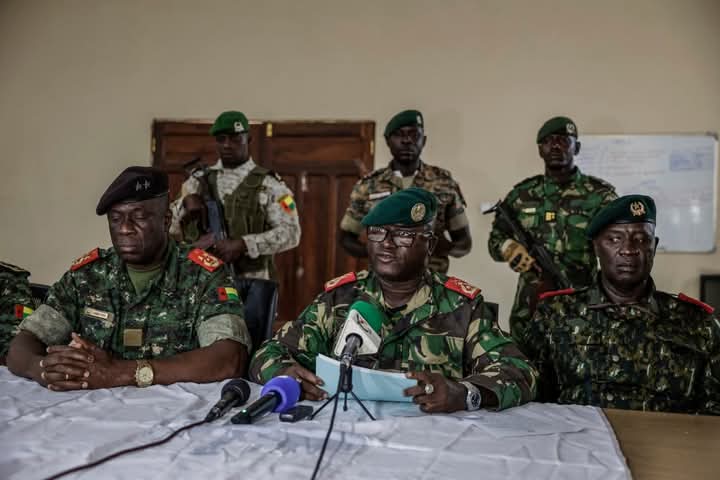
During a ceremony at military headquarters, General Horta N’Tam, the army chief of staff, took the oath of office, stating, “I have just been sworn in to lead the High Command,” AFP journalists reported. He added at a press conference that the military’s actions were necessary “to block operations that aimed to threaten our democracy.” Dozens of heavily armed soldiers were deployed at the event.
On Wednesday, a group of officers announced they had seized “total control” of the nation, suspending the electoral process as Guinea-Bissau awaited the results of Sunday’s vote, in which Embaló had been expected to win. N’Tam, previously close to Embaló, said evidence had been “sufficient to justify the operation” and added, “necessary measures are urgent and important and require everyone’s participation.”
Situated between Guinea and Senegal, Guinea-Bissau has seen four coups since gaining independence from Portugal in 1974, along with multiple attempted coups.
General Denis N’Canha, head of the presidential military office, told journalists on Wednesday that the military had taken control “until further notice” after uncovering a plan involving “drug lords” and “the introduction of weapons into the country to alter the constitutional order.” The military also suspended “all media programming” and imposed a mandatory curfew, while closing all land, air, and sea borders, which General Lassana Mansali said had been reopened by Thursday.
President Embaló was arrested on Wednesday and held at the general staff headquarters, where he was reportedly “well treated,” according to a military source. Other senior officials, including “the chief of staff and the minister of the interior,” were also detained, and opposition leader Domingos Simões Pereira, barred from last weekend’s presidential election by the Supreme Court, was reportedly arrested as well.
The Economic Community of West African States (ECOWAS) condemned the coup, reiterating its “strict zero-tolerance for unconstitutional changes of government.”
Guinea-Bissau, one of the world’s poorest nations and a major hub for drug trafficking between Latin America and Europe, has long been plagued by political instability. UN Secretary-General António Guterres was “following the situation with deep concern,” while Portugal urged restraint, warning against “any act of institutional or civic violence.”
Sadibou Marong, director of Reporters Without Borders’ Sub-Saharan Africa office, criticised the suspension of media operations, stating, “The population must be able to be informed about what is happening in the country, especially in this context of political crisis.”
The coup in Guinea-Bissau forms part of a wider wave of military takeovers in West Africa, following similar events in Mali, Burkina Faso, Niger, and Guinea in recent years.
Advertisement