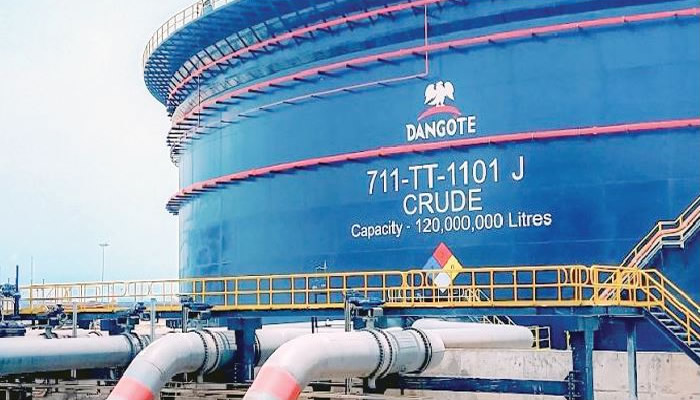
Major oil marketers have maintained that the Dangote Petroleum Refinery, despite cutting petrol prices and ramping up local production, cannot single-handedly meet Nigeria’s fuel requirements.
They warned that relying on one supplier is already causing strain in the downstream sector, leading to supply gaps, logistics challenges and price uncertainty.
The Executive Secretary of the Major Energies Marketers Association of Nigeria (MEMAN), Clement Isong, made this known while reacting to the recent reduction in the refinery’s gantry price from about ₦828 per litre to ₦699 per litre. The price cut has pushed pump prices down to around ₦739 per litre at several MRS filling stations across the country.
Isong said although all MEMAN members currently source petrol from the Dangote refinery, practical challenges make it impossible for the facility to be Nigeria’s only supply point.
“Every one of my members buys from Dangote. But if everybody in Nigeria is buying from a single source, there will be times when it cannot meet their needs, what they want, when they want it, and how they want it,” he explained.
According to him, marketers often have to look elsewhere when supply timing or delivery options do not align with their needs. Some import fuel directly, while others buy from third parties who have already imported or lifted products from the refinery.
He added that fuel supply needs differ widely among marketers, noting that a single refinery operating from one location naturally creates bottlenecks.
“Sometimes marketers need fuel delivered by vessel in certain volumes; sometimes they want to load by gantry.
When everyone is lining up at the same place, it becomes extremely difficult to meet all demands efficiently,” Isong said.
He disclosed that some major marketers are already experiencing dry filling stations due to supply challenges, even though petrol is generally available nationwide.
“I visited some of my members’ stations today and found that some were dry. Not because there’s no petrol in the country, but because of the challenges in getting supply at the right time and in the right quantity,” he said.
Isong described the current market situation as “chaotic,” warning that dependence on a single source exposes marketers to risks that could disrupt station operations.
“If you depend on one source and you miss supply even for one day, your stations may go dry unless you buy from someone else often at a premium,” he noted.
Despite these challenges, MEMAN dismissed fears of an impending fuel scarcity, stressing that Nigeria currently has excess petrol in circulation and more supplies are still arriving.
Isong said the Nigerian Midstream and Downstream Petroleum Regulatory Authority (NMDPRA) planned adequately for the festive season by approving import licences, ensuring product availability.
However, he explained that price volatility has made marketers cautious, with many avoiding bulk purchases to reduce potential losses.
“There is a glut in the system. There are excess products, but people are being careful. Nobody wants to buy large volumes now because if prices crash suddenly, the losses will be massive,” he warned.
According to him, losses are being recorded across the value chain, including by the Dangote refinery itself.
“Everybody is losing money. Even the producer has admitted it,” Isong said.
Last week, the Dangote refinery stunned depot owners and marketers by slashing its petrol price by ₦129 per litre. Speaking at a press briefing, Dangote Group President, Aliko Dangote, accused some marketers of planning to keep pump prices high despite the reduction.
He vowed to enforce the new pricing regime, leading MRS stations to sell petrol at ₦739 per litre. As more MRS outlets in Lagos and Ogun states adopted the new price, motorists began avoiding stations selling at higher rates.
This triggered a wave of price cuts across the market, with some stations reducing prices by nearly ₦100 per litre, in many cases selling below their cost price highlighting the intensity of the ongoing price war.
Reacting to the situation, the spokesperson of the Independent Petroleum Marketers Association of Nigeria (IPMAN), Chinedu Ukadike, said marketers who fail to adjust prices would lose customers.
“Patronage is determined by price. Wherever fuel is cheaper, that’s where people will go. The market now regulates itself,” he said.
Ukadike disclosed that IPMAN has entered into a partnership with the Dangote refinery, noting that independent marketers are now playing a key role in evacuating its products.
“Dangote has invited IPMAN to lift products directly. Since then, we’ve given the refinery tremendous patronage,” he said.
Meanwhile, the Dangote refinery insists it has the capacity to meet Nigeria’s daily petrol demand. Dangote recently said the plant supplies about 50 million litres of petrol daily and accused the regulator of issuing excessive import licences while its storage tanks were full.
Officials of the refinery have backed his claim, insisting the facility can adequately supply fuel nationwide.
Advertisement