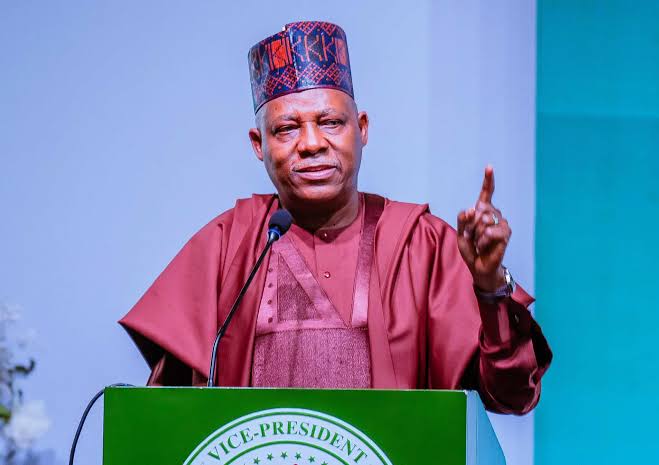
Vice President Kashim Shettima has said Nigeria’s power sector reforms have moved beyond policy pronouncements and are now yielding tangible results, as the Niger Delta Power Holding Company (NDPHC) marked its 20th anniversary.
Speaking at the anniversary celebration held at the State House Banquet Hall in Abuja, Shettima said recent reforms especially the Electricity Act 2023 have reshaped the electricity market and positioned NDPHC for a more commercially driven future.
In a statement issued by NDPHC’s Head of Corporate Communications and External Relations, Emmanuel Ojor, the Vice President described the new law as a “defining turning point” that has given the company stronger legal backing, institutional stability and the credibility to compete and form partnerships in an increasingly open energy market.
Shettima, who also chairs the NDPHC board, explained that the company is transitioning from being largely an intervention-driven agency to a commercially disciplined, market-focused enterprise, while still maintaining its national development responsibilities.
According to him, the board sees the 20-year milestone as an opportunity for institutional growth and reform.
“Our focus is on extracting more value from existing assets, strengthening contracts and market participation, ensuring governance-led commercialisation, managing risks responsibly and investing in our people,” he said.
He assured Nigerians that the board would continue to provide strategic leadership, uphold strong governance standards and protect shareholder value on behalf of the Nigerian people, while aligning NDPHC’s operations with national energy and development priorities.
The Vice President also credited President Bola Tinubu with restoring investor confidence in the power sector, noting that the administration’s reform-driven approach has laid the foundation for long-term stability.
“At a time when the sector needed not just policy statements but real results, the President chose discipline and reform over illusion. He has restored confidence and created the conditions for institutions like NDPHC to thrive,” Shettima said.
In her remarks, NDPHC Managing Director, Jennifer Adighije, said the company’s impact over the past two decades has gone far beyond power generation, extending across transmission and distribution.
She revealed that NDPHC has added more than 9,000 megavolt-amperes of transformer capacity to the national grid and has constructed transmission substations, line-bay extensions and hundreds of kilometres of transmission lines nationwide.
According to her, no other public or private entity has invested as extensively in strengthening Nigeria’s power value chain.
“All of this has been made possible by the determination of the board, management and the dedication of our staff,” Adighije said.
She added that the company is now adopting a more customer-focused approach in line with the Electricity Act, while deepening partnerships with bilateral donors, eligible customers, regional players under the West African Power Pool and other market participants.
Adighije also disclosed that, with the approval of President Tinubu and the Minister of Power, NDPHC has approached the bond market under the power sector refinancing plan to raise funds to offset government debts owed to power generation companies.
She said the initiative, being driven by the Ministry of Finance, is expected to unlock liquidity in the sector and help stabilise electricity supply nationwide.
Describing the plan as a potential “game-changer,” she stressed that settling outstanding debts would significantly improve confidence and performance across the electricity value chain.
Also speaking at the event, Minister of Power, Adebayo Adelabu, described NDPHC as a cornerstone of Nigeria’s electricity framework, noting that through the National Integrated Power Project, the company has built one of Africa’s largest portfolios of government-backed power assets.
He revealed that NDPHC recently restored 345 megawatts of electricity to the national grid, including 120MW from Omotosho NIPP, 112.5MW from Benin NIPP and another 112.5MW from Ihovbor NIPP.
Adelabu also highlighted the Light Up Nigeria project, which aims to support industrialisation by providing reliable electricity to industrial clusters across the country.
“These achievements reflect the wider gains of power sector reforms under President Tinubu’s Renewed Hope Agenda, which prioritises reliability, access and investment,” he said.
The Minister of State for Petroleum Resources (Gas), Ekperikpe Ekpo, praised Adighije’s leadership, describing her performance as impressive despite her relatively short time in office.
He stressed that sustainable electricity supply remains critical to Nigeria’s industrial growth and economic development, while commending the strategic guidance of the NDPHC board under the Vice President.
Established in 2005 under the National Integrated Power Project, NDPHC was created as a government intervention vehicle to fast-track power generation, transmission and distribution infrastructure across Nigeria.
The anniversary comes at a time when the country is intensifying efforts to stabilise the electricity market through legislative reforms, infrastructure rehabilitation and financial restructuring, with NDPHC increasingly serving as a bridge between government intervention and a market-driven power sector.
Advertisement