Former members of the National Assembly have endorsed President Bola Tinubu as their preferred candidate for the 2027 general election and called for the inclusion of rotational presidency in Nigeria’s Constitution to promote long-term national unity.
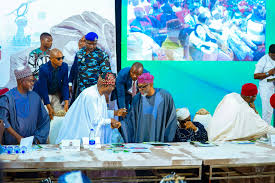
The endorsement came under the platform of the National Forum of Former Legislators (NFFL) at the end of its 2026 National Summit held on Saturday in Abuja. The summit was themed “National unity and nation building beyond 2031.”
In a communiqué issued after the meeting, the forum said its decisions were guided by the need to strengthen national cohesion and foster peaceful coexistence among Nigeria’s diverse ethnic groups.
The former lawmakers unanimously adopted President Tinubu as their sole candidate for the 2027 polls, stressing that dialogue and peaceful engagement must remain Nigeria’s primary tools for resolving political, social and regional disputes.
According to the communiqué, Nigerian challenges should always be addressed by Nigerians through dialogue, constitutional processes and democratic means.
On the issue of power rotation, the forum resolved that the presidency should return to the North in 2031 after the South completes its turn, in line with the principles of fairness, inclusion and national balance.
To prevent recurring political tension and uncertainty, the NFFL urged that the rotational arrangement between the North and South be clearly entrenched in the Constitution. The group said this would promote equity, strengthen national unity and provide clarity for future generations.
The forum also passed a vote of confidence in the Tinubu-led administration, resolving that the President should be supported to complete two full terms in office.
According to the communiqué, supporting the President to complete eight years would help consolidate ongoing reforms, strengthen national unity and deepen democratic governance.
The former lawmakers reaffirmed their commitment to a united, peaceful and prosperous Nigeria and urged political leaders and citizens alike to uphold democratic values, justice and national cohesion.
Speaking at the summit, the Chief of Staff to the President, Femi Gbajabiamila, warned that Nigeria’s survival and relevance in an increasingly unstable global environment depend largely on national unity. He described cohesion as a strategic necessity rather than a moral choice.
Gbajabiamila said global uncertainty has made experienced leadership and internal unity more critical than ever, adding that the forum’s decision to reconvene and contribute to national discourse reflected its enduring commitment to Nigeria.
He conveyed President Tinubu’s appreciation to the forum, describing the NFFL as a reservoir of experience whose insights continue to guide the administration’s policy direction.
According to him, the institutional memory of former lawmakers is a valuable national asset that must be deliberately harnessed to shape present decisions and future policies, particularly in strengthening the economy.
Gbajabiamila stressed that nation-building goes beyond election cycles and individual administrations, describing it as a continuous process.
He noted that the 1999 Constitution envisioned Nigeria as one united people, not a collection of rival groups, adding that unity remains a shared responsibility.
The Chief of Staff warned that internal divisions could weaken Nigeria’s ability to protect its interests in a rapidly changing global order, exposing the country to economic and security risks.
He described rotational presidency as a stabilising political arrangement rooted in national wisdom and cautioned against allowing personal ambition to undermine the delicate balance that holds the country together.
Gbajabiamila also warned against ethnic and religious politics, saying such practices erode trust and weaken the foundations of the state.
Earlier, the NFFL National Coordinator, Raphael Igbokwe, said the forum’s position on power rotation followed extensive consultations across both the Northern and Southern regions.
He explained that after a series of dialogue sessions, members collectively agreed that, in the interest of unity, peace and national development, the South should be allowed to complete its eight-year term.
Advertisement