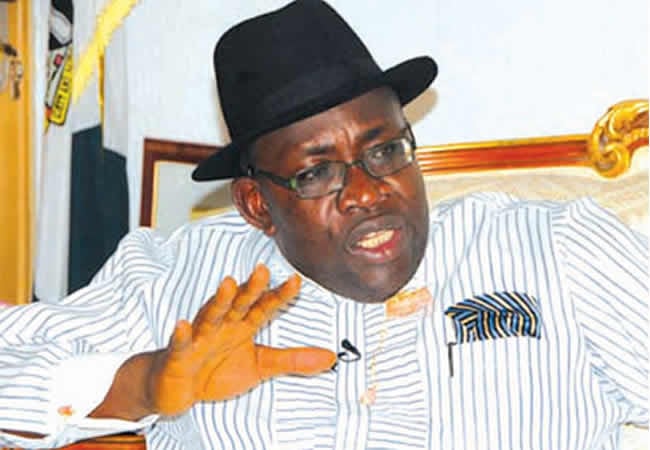
Former Bayelsa State Governor and Senator representing Bayelsa West, Seriake Dickson, has said Nigeria is not yet ready for electronic voting, describing the push for “real-time” transmission of election results as unnecessary.
Speaking on ARISE News on Tuesday, Dickson argued that the concept of real-time transmission is often misunderstood and overstated.
“What exactly do we mean by real time? Nigeria is not conducting electronic voting where citizens press a button and their votes are instantly uploaded to a portal,” he said.
He described the phrase “real time” as superfluous, stressing that its inclusion in the Electoral Act would not automatically guarantee transparency.
“The term ‘real time’ in this context is actually unnecessary. It does not, on its own, ensure a transparent election. It should not have been inserted in the first place. And it is never too late to correct an error,” he stated.
Dickson also dismissed claims that the Senate’s recent decision on the Electoral Act Amendment Bill amounted to a setback for democracy.
“I do not see today’s proceedings and outcome as a loss for democracy,” he said.
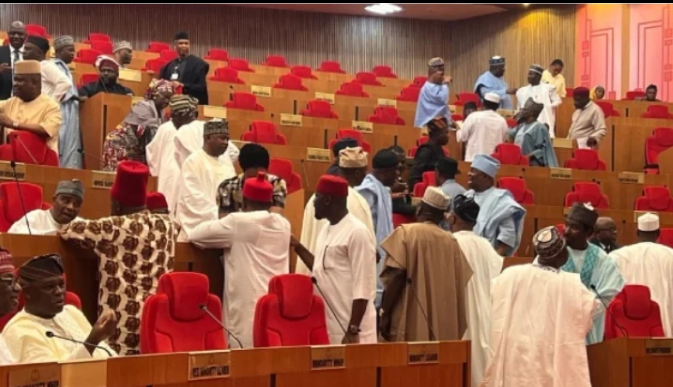
His remarks followed an emergency plenary session of the Senate, which reconsidered Clause 60(3) of the bill after public backlash. The Senate approved the transmission of election results to the Independent National Electoral Commission’s Result Viewing Portal (IREV) while retaining manual collation as a backup in cases of network failure. However, lawmakers declined to make electronic transmission compulsory and rejected a provision mandating real-time upload of results.
Critics have warned that failing to explicitly require real-time transmission could create room for manipulation.
Dickson clarified that he was expressing personal views and not speaking on behalf of the Senate.
“I am not here as the Senate’s spokesperson. I am speaking as someone deeply involved in the process, a ranking member of the committee, and a participant in today’s proceedings,” he said.
He noted that discussions around electronic transmission had spanned nearly two years, involving workshops, joint committee sessions, and consultations with INEC.
“This issue has been under consideration for about two years, with multiple engagements between Senate and House committees, as well as interactions with INEC,” he explained.
The senator revealed that he was absent during the earlier controversial decision due to bereavement.
“I was not present when the Senate made that decision about a week ago. I had just lost a close brother, who was the sitting deputy governor of my state. Today was my first day back in the Senate because of the importance of this matter,” he said.
Tracing resistance to electronic transmission to longstanding political divisions, Dickson said similar opposition surfaced during the 9th Senate.
“Electronic transmission has always been contentious. Even in the 9th Senate, there was strong resistance. The party in power has consistently shown reluctance toward such reforms,” he said.
He disclosed that both the Senate and House committees had initially agreed to safeguard the IREV system, and the House passed the report without controversy.
“There was unanimity. The House of Representatives adopted the same report seamlessly. That reflected what we had all agreed upon,” he said, describing the earlier reversal on the Senate floor as unfortunate.
According to him, INEC had assured lawmakers of its readiness to implement electronic transmission.
“What happened last week in the Senate was unfortunate, particularly when INEC had confirmed its capacity to transmit results electronically,” he added.
Dickson said he confronted Senate leadership upon his return and was assured that a compromise would be reached.
“They assured me that a middle ground would be found,” he said.
Emphasising the importance of polling unit results, he maintained that the EC8A form remains the primary legal evidence of election outcomes.
“The primary proof of victory is the EC8A. Once votes are counted, agents sign, and copies are distributed, INEC requires presiding officers to upload the results to IREV. That, in my view, is sufficient,” he said.
Although he expressed reservations about the provision allowing manual collation in the event of network failure, he acknowledged that parliamentary decisions are guided by majority consensus.
“I do not agree with the proviso included, but parliament operates on majority decisions,” he said, adding that electronic transmission remains mandatory under the amended clause.
“Every presiding officer shall transmit results electronically. That is mandatory. That is what we passed today,” he stressed.
On reconciling differences between Senate and House versions of the bill, Dickson said he would favour the House’s position, which reflects earlier joint agreements.
“If I were on the conference committee, I would adopt the House version because it mirrors our initial consensus,” he said.
He also raised concerns about proposals to compel political parties to adopt direct primaries, describing it as an APC-driven concept that should not be imposed on other parties, particularly smaller ones.
“Direct primaries were introduced by the APC. They have no right to force that model on all other parties,” he argued.
On accountability, Dickson maintained that INEC bears ultimate responsibility for ensuring credible elections, noting that existing guidelines already mandate electronic transmission to IREV.
He also defended the Supreme Court’s 2023 ruling, stating that IREV was never intended to replace the EC8A as primary evidence in election disputes.
“The IREV was never designed to serve as the primary legal proof. The EC8A remains central,” he said.
Concluding, Dickson said electoral reform must be gradual.
“Progress comes incrementally. It is not always about having everything your way. Making electronic transmission mandatory is a step forward,” he said.
Advertisement