
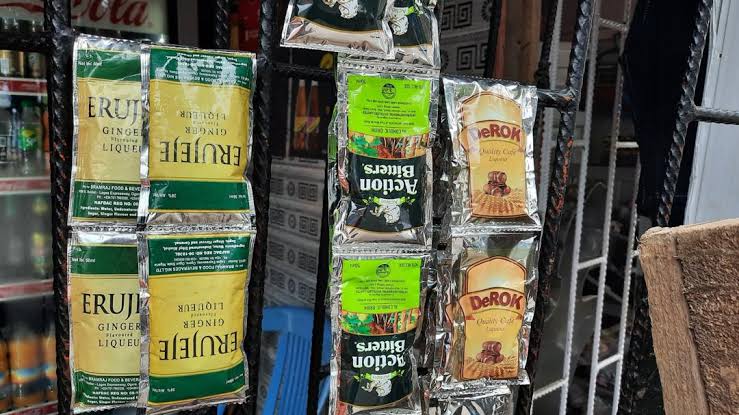
The Federal Government on Tuesday officially launched a nationwide campaign to enforce the ban on alcoholic beverages sold in sachets and small bottles under 200 millilitres. The move is aimed at curbing underage drinking and limiting harmful alcohol consumption patterns across Nigeria.
The joint press briefing, held in Abuja, was organized by the National Orientation Agency (NOA) in collaboration with the National Agency for Food and Drug Administration and Control (NAFDAC) and the Federal Competition and Consumer Protection Commission (FCCPC).
The ban, which came into effect on January 1, 2026, prohibits the production, sale, and distribution of alcohol in sachets and PET or glass bottles smaller than 200ml. NAFDAC Director-General, Professor Mojisola Adeyeye, explained that the campaign follows years of consultations, regulatory extensions, and alarming survey results on alcohol consumption among minors.
“We are here to ensure the ban on sachet alcohol and small bottles is enforced across the country,” Adeyeye said. “These products have been identified as major contributors to underage drinking because they are cheap, portable, and easy to conceal.”
Adeyeye traced discussions on regulating high-strength alcohol in sachets back to 2018, noting that industry groups initially resisted the move, citing concerns about the survival of their businesses. A five-year moratorium was granted to allow companies to restructure, followed by a one-year extension in 2024. Enforcement began in earnest after these deadlines lapsed.
Survey findings underpinning the renewed crackdown revealed worrying trends:
Over 50% of minors obtain alcohol themselves from retailers.
About 49.9% of them purchase drinks in sachets or small bottles.
Children as young as nine have been reported consuming alcohol, with binge drinking occurring in some states.
Adeyeye highlighted the health risks, warning that underage drinking can permanently damage the hippocampus and prefrontal cortex, impairing learning, memory, and impulse control. Early alcohol consumption also increases the likelihood of addiction and can lead to progression to harder drugs. She linked alcohol abuse to broader social problems, including banditry and kidnapping.
“Limiting access through the ban on sachets and small bottles is a critical step toward protecting our youth,” she said.
NOA Director-General, Lanre Issa-Onilu, described the campaign as a nationwide effort to safeguard Nigerians. “Sachet alcohol has been dangerously accessible, especially in rural and semi-urban communities. When affordability meets vulnerability, the consequences are severe,” he said.
Issa-Onilu pledged to use NOA’s extensive network of 818 offices across all 774 local government areas to drive awareness and ensure compliance. He called on parents, community leaders, retailers, and distributors to support the government’s enforcement efforts.
“Together, through awareness, compliance, and vigilance, we can build a healthier, safer, and more responsible nation,” he concluded.
Advertisement