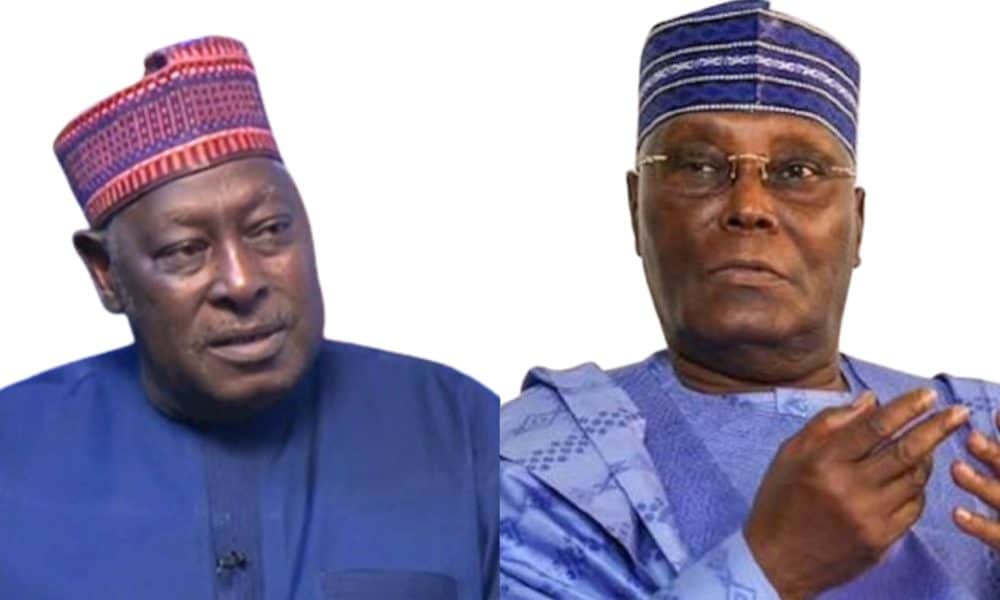
The camp of the African Democratic Congress (ADC) presidential candidate, Atiku Abubakar, has strongly rejected allegations by former Secretary to the Government of the Federation, Babachir Lawal, that the party’s presidential primary was manipulated.
The response came shortly after Lawal announced his resignation from the ADC and accused Atiku of influencing the outcome of the party’s nationwide presidential primaries.
In a statement issued on Monday by Atiku’s Senior Special Assistant on Public Communication, Phrank Shaibu, the former Vice President’s camp described the allegations as baseless and lacking any credible evidence.
According to the statement, the presidential primary reflected the wishes of ADC members across the country and was conducted in a transparent and democratic manner.
“Having chosen to malign a democratic process, insult thousands of ADC members nationwide and make grave allegations without presenting a shred of evidence, it has become necessary to set the record straight,” the statement read.
The Atiku camp argued that Lawal failed to provide any proof to substantiate claims that the primary election was rigged.
It maintained that the exercise was conducted across thousands of wards nationwide and produced what it described as a clear and decisive outcome.
“The ADC presidential primaries were conducted across thousands of wards and produced a clear result. Mr Lawal has presented no documents, no verifiable facts, no credible witnesses and no evidence whatsoever to support his allegations,” Shaibu stated.
The statement also questioned Lawal’s criticism of the primary process, noting that he appeared willing to accept the outcome of other contests conducted under the same framework.
The Atiku camp specifically pointed to the emergence of Omar Suleiman, described as Lawal’s cousin, as the ADC governorship candidate in Adamawa State.
It argued that Nigerians were entitled to ask why the process was considered credible in one instance but allegedly flawed when it produced a presidential candidate Lawal did not support.
Beyond the primary election dispute, Atiku’s camp accused the former SGF of political inconsistency and suggested that his reaction was motivated more by dissatisfaction with the result than by concerns over electoral integrity.
“What appears to have unsettled Mr Lawal is not the conduct of the primaries but the outcome. Democracy guarantees participation, not victory. One cannot celebrate democracy when it produces a preferred result and condemn it when it does not,” the statement added.
The response also revisited controversies surrounding Lawal’s tenure in government, including the 2017 contract scandal linked to the Presidential Initiative on the North-East, popularly referred to as the “grass-cutting” controversy. Lawal has consistently denied any wrongdoing in the matter.
Furthermore, Shaibu criticised what he described as attempts to introduce ethnic and religious sentiments into the debate over the primary election.
According to him, such rhetoric offers no solutions to the country’s pressing challenges, including insecurity, unemployment and rising living costs.
“Having failed to persuade party members to support his preferred candidate, he now seeks refuge in divisive identity politics,” the statement said.
Defending Atiku’s credentials ahead of the 2027 general election, Shaibu said Nigerians would ultimately judge candidates based on governance, economic reforms, national security and their ability to address the country’s challenges.
“The Nigerian people know Atiku Abubakar. They know his record in public service, his achievements in business and his commitment to national unity and economic development,” he stated.
The statement concluded by insisting that the outcome of the ADC presidential primary remains final and that post-primary disagreements would not change the decision made by party members.
According to Atiku’s camp, the 2027 presidential election will ultimately be determined by Nigerians at the ballot box rather than by internal party disputes or grievances arising from the primary process.