Civil society organisations, non-governmental organisations and youth leaders in Osun State have unveiled the Osun Youth Development Charter 2026–2030, a framework aimed at capturing the priorities of young people and strengthening their participation in governance and development.
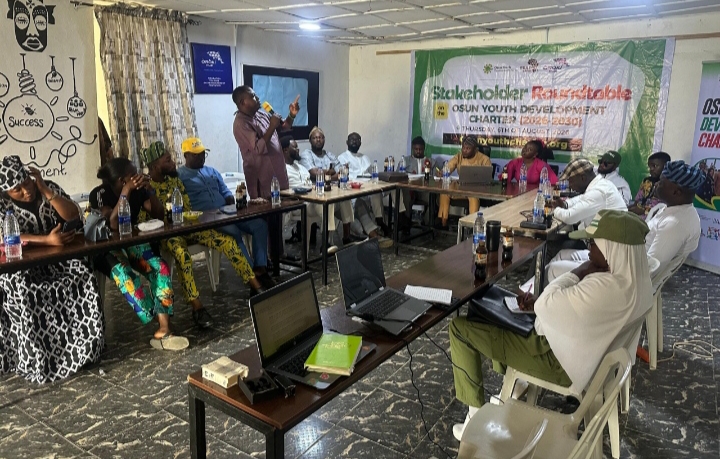
The charter was presented on Wednesday at a stakeholders’ roundtable held at Osogbo, where participants also engaged young people currently serving in government to obtain recommendations and input towards strengthening the document.
The initiative, led by youth-focused civil society organisations, is designed to provide a platform for young people to articulate their concerns, engage government and advocate policies addressing employment, education, healthcare, technology, agriculture and other areas affecting their development.
Speaking at the engagement, Team Lead of SEAD Africa Initiative and Co-Convener of the Osun Youth Development Charter, Semiu Abidemi Adabanija, said the document was developed through online surveys and public memoranda gathered from young people across the state.
Adabanija said the initiative was driven by civil society organisations, non-governmental organisations and youth leaders rather than political interests.
“Those who started this are not politicians, but people from civil society and youth-focused organisations working in Osun,” he said.
According to him, the consultation identified eight major pillars which reflect the priorities of young people, with job creation and Micro, Small and Medium Enterprises development emerging as the leading concern.
The eight pillars are Job Creation and MSME Development, Digital Economy, Education and Skills Development, Health and Wellbeing, Agriculture, Green Economy, Inclusive Governance, and Human Capacity Development.
The charter also advocates greater participation of competent and professional young people in government through designated opportunities within the state administration.
Adabanija stressed that the initiative was non-partisan, saying the priority was to ensure that the recommendations contained in the charter translated into practical government policies.
“We want to make sure that this is not just a document, but to see to the implementation of it. We want to present it to the Osun State Government for implementation based on their alignment and plans,” he said.
Stakeholders at the roundtable welcomed the initiative and called for unity, political neutrality and sustained engagement to ensure that the charter remains relevant beyond individual administrations.
Olamide Tiamiyu, Chief Press Secretary to the Speaker of the Osun State House of Assembly, commended the conveners for prioritising youth and women’s development.
Tiamiyu urged youth organisations to remain united and intensify advocacy to move the charter from documentation to actual policy implementation.
The Special Adviser to the Governor on Civil Society Engagement, Ebenezer Olufemi Ige, described the charter as a comprehensive document capable of contributing to youth development in the state.
Ige advised the conveners to strategically engage the executive and political structures of government to secure support for the implementation of the recommendations.
Another stakeholder, Maruff Taiwo, stressed the importance of maintaining the political neutrality of the charter to ensure its continuity and relevance beyond 2030.
The organisers said the consultation process would continue through engagements with members of the state executive cabinet, lawmakers and other relevant government and youth stakeholders.
They also noted that the initiative had previously engaged stakeholders, including the member representing Ede Federal Constituency in the House of Representatives, Hon. Bamidele Salam, as well as the National Youth Council of Nigeria and the National Association of Osun State Students.
The organisers said these engagements were part of efforts to broaden consultations and ensure that the charter reflects the realities and aspirations of young people across Osun.
The stakeholders said their ultimate goal was to transform the charter from a statement of youth priorities into an actionable framework capable of influencing government policies, strengthening youth representation in governance and expanding opportunities for young people across the state.