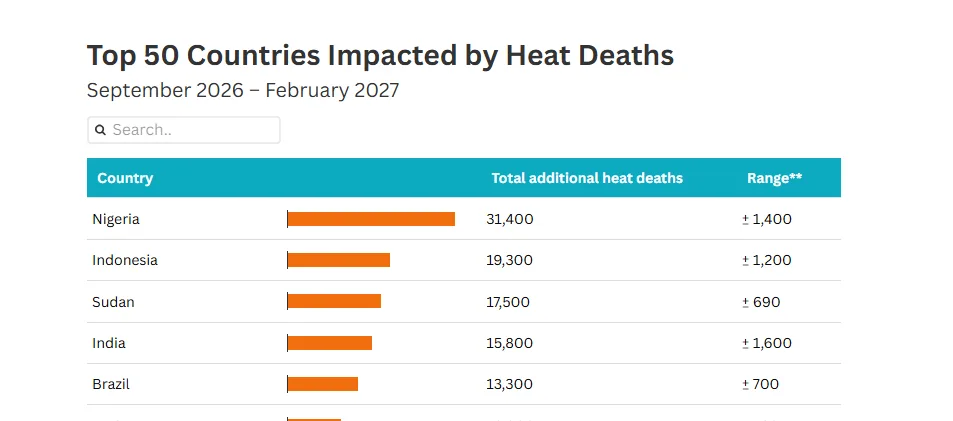
Nigeria could record an additional 31,400 heat-related deaths between September 2026 and February 2027 as an unusually strong El Niño weather pattern intensifies, a report by the Climate Impact Lab has warned.
The projection places Nigeria among the countries expected to suffer the highest number of additional heat-related deaths globally during the six-month period, with nearly half of the 66,800 deaths projected across the Sahel region expected to occur in the country.
The report, published on September 22, 2026, and titled 451,000 at Risk: Where Action Can Save Lives During the Super El Niño, estimates that 451,000 additional heat-related deaths could occur worldwide between June 2026 and February 2027 compared with a normal year.
The researchers project that global land temperatures will be 1.2 degrees Celsius above normal in the coming months, with 44 per cent more extremely hot days than would typically be expected.
Explaining the human cost of the projections, Michael Greenstone, a co-founder of the Climate Impact Lab and professor of economics at the University of Chicago, said the figures represented people going about their everyday lives.
“We have long been able to predict the impacts of temperatures on crops, and now we can predict their impact on the worst outcome—death. The result is that we now can estimate that 451,000 people may die in the coming months due to El Niño.
This is such a large number that it can be numbing, but it is made up of parents and children, grandparents and neighbors, people going to work, caring for families, and living their lives,” Greenstone said.
The researchers warned that the unusually high temperatures expected during the El Niño event resembled conditions that climate change could make commonplace in about two decades.
“This is more than a hot summer, it’s a postcard from the future,” the report stated.
It added, “The anomalously warm temperatures that most of the globe will see during this El Niño event are a ‘postcard from the future’: while they feel anomalous now, they will become normal just a few decades into the future.”
The report said the projections offered an opportunity for governments and humanitarian organisations to identify vulnerable populations and direct resources towards areas where interventions could save the most lives.
“With these timelines in mind, there is time to reduce the numbers of lives lost by tens of thousands with targeted action,” it stated.
Nigeria faces high projected toll
The Climate Impact Lab estimated that Nigeria could record 15,400 additional heat-related deaths between December 2026 and February 2027 alone.
The report stated, “The most impacted countries across the Sahel are forecasted to see an additional 66,800 heat deaths from September-February compared to a normal year, with nearly half of those lives being lost in Nigeria (31,400).
Elsewhere in the region, Sudan will face 17,500 additional heat deaths, Niger will face 10,000, and Chad 8,000.”
The researchers said the figures represented additional deaths compared with those expected in an average year, rather than the total number of deaths from heat.
Call for urgent intervention
The report identified heat warnings, health outreach to vulnerable people, cooling centres, hydration stations, protections for workers and increased health system capacity as measures that could help reduce the toll.
It also highlighted heat early-warning systems and action plans that enable health officials to visit vulnerable residents, expand water availability and monitor symptoms associated with extreme temperatures.
The researchers called for governments to invest in measures that could protect people during the immediate period of extreme heat and prepare communities for rising temperatures in the longer term.
Tamma Carleton, a co-author of the report and an assistant professor at the University of California, Berkeley, said emergency responses were necessary but should be accompanied by long-term planning.
“Increasing emergency response and better targeting our efforts can save many lives this year. But 20 years from now, once today’s extreme temperatures become the new normal, we don’t want to be in a constant state of emergency,” Carleton said.
She added, “We need to mobilize resources now to design, deploy, and evaluate the preparation and planning tools that will save lives in the years ahead.”
The researchers said their projections were based on the relationship between temperature and excess mortality across 24,378 regions worldwide, combined with seasonal temperature forecasts.
The estimates compare projected heat-related deaths with the average for the corresponding months between 1996 and 2025.
They said the projections could change as forecasts are updated and warned that heat-related deaths could continue rising beyond February 2027.