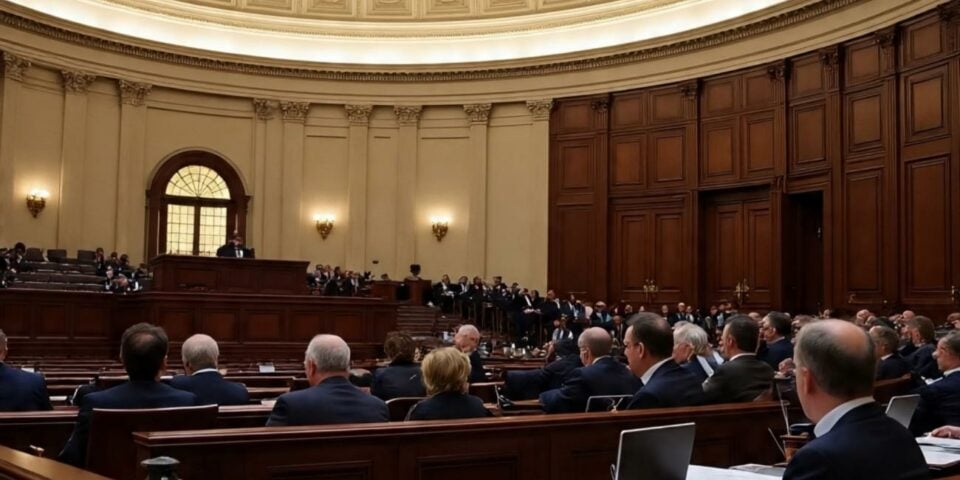
The United States House of Representatives has introduced a new bill aimed at holding Nigerian government officials accountable for alleged violations of religious freedom and human rights abuses.
The legislation, titled the “Nigeria Religious Freedom Accountability Act of 2025,” was sponsored by Republican lawmaker Marlin Stutzman of Indiana’s 3rd District and introduced on October 21, 2025.
According to information published on the official U.S. Congress website and obtained by PUNCH Online on Thursday, the bill has been referred to the House Committee on Foreign Affairs and the Committee on the Judiciary for review. Both committees are expected to examine the proposed law, filed as H.R.5808 in the 119th Congress, within their respective jurisdictions before it proceeds to the House floor.
In Section 2(a) of the bill, lawmakers set out the main objective, stating, “The President shall impose the sanctions described in Executive Order 13818 (50 U.S.C. 1701 note; relating to blocking the property of persons involved in serious human rights abuse or corruption) on the persons identified in the report required under subsection (b).”
Under Subsection (b)(1), the bill mandates that within 90 days of enactment—and annually thereafter—the U.S. Secretary of State must submit to Congress a comprehensive report naming Nigerian officials found to have promoted or tolerated religious persecution.
The provision specifically targets, “Federal officials or state governors who have, during the period specified in paragraph, promoted, enacted, or maintained Nigerian blasphemy laws, including through public advocacy, legislative action, or executive enforcement directives; or tolerated violence by non-state actors invoking religious justifications to commit acts of violence, including persons designated as foreign terrorist organisations… or specially designated global terrorists pursuant to Executive Order 13224.”
The bill also extends accountability to, “Judges, magistrates, prison officials, or other judicial or law enforcement authorities who have enforced blasphemy laws, including through prosecution, conviction, imprisonment, or other deprivation of liberty of individuals pursuant to such laws.”
The reporting period covers a 10-year window preceding enactment, ensuring both past and ongoing violations are scrutinised.
In addition, the bill reinforces Nigeria’s recent redesignation as a Country of Particular Concern (CPC) under U.S. law—subjecting the nation to possible sanctions for severe breaches of religious freedom.
The legislation reads, “In reports required under Section 402(b)(1)(A) of the International Religious Freedom Act of 1998 (22 U.S.C. 6442(b)(1)(A)) and concurrent reviews required under section 301(a) of the Frank R. Wolf International Religious Freedom Act of 2016 (22 U.S.C. 6442a(a)), the Secretary of State shall designate, for engaging in or tolerating systematic, ongoing, and egregious violations of religious freedom: the Federal Republic of Nigeria as a Country of Particular Concern (CPC); and Boko Haram and ISIS-West Africa as Entities of Particular Concern (EPC).”
If passed, the proposed law would compel the U.S. government to impose sanctions on Nigerian officials and organisations accused of aiding or ignoring acts of religiously motivated violence — signalling an escalation of Washington’s stance on Nigeria’s human rights record.
Earlier, Reports indicate that 12 northern governors, senior judges, and traditional rulers could face sanctions as the U.S. Senate considers a separate version of the bill sponsored by Republican Senator Ted Cruz.
That legislation, also titled the Nigeria Religious Freedom Accountability Act of 2025, classifies Nigeria as a “Country of Particular Concern” and proposes direct punitive measures against public officials and religious leaders accused of enabling persecution.
Under the Senate bill, the U.S. Secretary of State would, within 90 days of passage, submit a list of Nigerian governors, judges, and monarchs who have “promoted, enacted, or maintained blasphemy laws” or “tolerated violence by non-state actors invoking religious justification.”
Meanwhile, former President Donald Trump recently declared Nigeria a “Country of Particular Concern” on Truth Social and directed Secretary of State Marco Rubio to act swiftly.
Trump lamented that “thousands of Christians were being killed in Nigeria” and tasked Congressman Riley Moore, Chairman Tom Cole, and the House Appropriations Committee to “immediately look into the matter and report back.”
Additionally, a new U.S. Congress bill recommends targeted sanctions and travel restrictions on individuals and entities accused of serious violations of religious freedom in Nigeria, including the Miyetti Allah Cattle Breeders Association of Nigeria and Miyetti Allah Kautal Hore.
According to the bill, sanctions would include visa bans and asset freezes on identified members.
Representative Christopher Smith, who introduced the bill on Tuesday, commended Trump for redesignating Nigeria a “Country of Particular Concern,” adding that the U.S. also classifies “Fulani-Ethnic Militias” operating in Benue and Plateau States as Entities of Particular Concern under the International Religious Freedom Act.
Advertisement