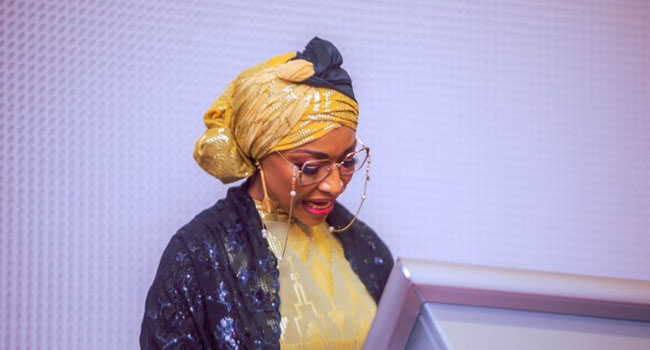
The Minister of Art, Culture and Creative Economy, Hannatu Musawa, has called on Nigerian women to close ranks and work together if they are to secure meaningful representation in politics and governance.
Musawa made the appeal on Tuesday in Ikenne Remo, Ogun State, during a special dialogue organised by the H.I.D. Awolowo Foundation with the theme “Breaking Barriers or Standing Still? Nigerian Women in Politics 30 Years After Beijing.” The event also marked the 110th posthumous birthday of Chief (Mrs) H.I.D. Awolowo.
She noted that although Nigerian women have historically shown strong capacity for mobilisation, citing icons like Funmilayo Ransome-Kuti, H.I.D. Awolowo and Margaret Ekpo, their lack of unity continues to hinder their political advancement.
“We are powerful, yes, but we are not yet organising our power in ways that truly transform politics,” she said.
“Our movements are passionate but divided, our voices are loud but not always coordinated. When we are fragmented, the system easily ignores us.”
A communiqué issued after the dialogue and signed by Dr Tokunbo Awolowo-Dosumu stressed that Nigeria must embrace political practices that are inclusive, intergenerational, intersectional, and deliberately supportive of women if the nation hopes to secure a better future.
The ceremony was emotional, coming just days after the death of Segun Awolowo, the first grandson of the late matriarch. Several dignitaries attended, including Senator Daisy Danjuma, Ogun State Deputy Governor Noimot Salako-Oyedele, Senator Uche Ekwunife and Prof. Olabisi Aina.
Musawa reminded attendees that despite the commitments made under the 1995 Beijing Declaration, progress for Nigerian women has remained disappointingly slow.
She emphasised that unity across political parties, regions, religions, and ideologies is crucial if barriers to women’s political participation are to be dismantled.
“One woman breaking a barrier is inspiring,” she said. “Ten thousand women pushing that barrier together is unstoppable.”
She also encouraged collaboration between men and women to drive reforms, while paying glowing tribute to H.I.D. Awolowo, whom she described as a courageous leader whose legacy continues to inspire.
In her remarks, Senator Danjuma lamented the limited opportunities available to women in national politics, noting that countries making significant progress globally do so by ensuring at least 30 per cent female representation in governance.
Convener of the dialogue, Dr Awolowo-Dosumu, said the event was designed to reflect on women’s political journey since the Beijing conference. She recalled her mother’s bravery, including her decision to contest for Prime Minister in 1965 while Chief Obafemi Awolowo was imprisoned.
Although she acknowledged that statistics on women’s leadership remain discouraging, she urged young women to stay bold, persistent, and determined. She added that Nigerian women must ensure that “30 years after Beijing” becomes a renewed push for progress, not a story of stagnation.
Also speaking, Deputy Governor Salako-Oyedele appealed to political parties to adopt more women-friendly policies, including reserved quotas and reduced or waived nomination fees, to encourage greater female participation.