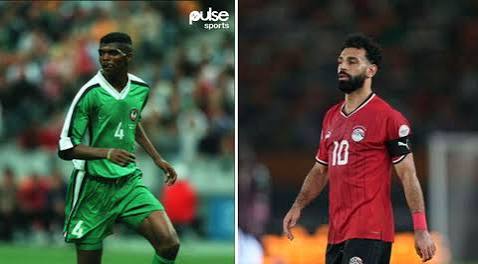
The Africa Cup of Nations (AFCON) remains the biggest prize in African football. Organised by the Confederation of African Football (CAF), the tournament crowns the continent’s best national team and commands a massive global audience.
Historically, Egypt sit at the top of the winners’ list with seven titles, followed by Cameroon with five, Ghana with four, and Nigeria with three.
As the 35th edition of AFCON approaches, with Morocco set to host the tournament from December 21, 2025, to January 18, 2026, Insightlinks Sport Arena has turned attention to some of Africa’s greatest footballers who, despite glittering careers, never managed to lift the coveted trophy.
1. Mohamed Salah (Egypt)
At 33, time is no longer on Mohamed Salah’s side. Egypt’s captain has come heartbreakingly close to AFCON glory, finishing runner-up twice, in 2017 and 2021.
Ironically, Egypt’s last AFCON triumph came in 2010, before Salah fully emerged on the international stage. The Pharaohs then missed three straight tournaments between 2012 and 2015, delaying his AFCON debut until 2017.
That debut ended painfully, with Egypt losing the final to Cameroon. Four years later, the story repeated itself as Egypt fell to Senegal on penalties. Salah, designated for a potential deciding kick, never got the chance to step up.
Injured during AFCON 2023, he watched helplessly as Egypt crashed out in the last 16. The 2025 tournament could be his final shot at completing an already remarkable international career.
2. Didier Drogba (Ivory Coast)
Few African players thrived on big occasions like Didier Drogba. A serial match-winner for Chelsea, finals were usually his territory. AFCON, however, told a different story.
Drogba led Ivory Coast to two AFCON finals, in 2006 and 2012, and penalties proved his undoing both times. Against Egypt in 2006, he missed in the shootout. Six years later, he blasted a late penalty over the bar against Zambia before the Ivorians again lost on spot kicks.
Despite consistent deep runs at the tournament, AFCON glory always slipped away. In a cruel twist of fate, Ivory Coast finally lifted the trophy in 2015, just months after Drogba retired from international football.
3. George Weah (Liberia)
George Weah remains Africa’s only Ballon d’Or winner, a testament to his brilliance at club level with Paris Saint-Germain and AC Milan.
International success, however, was limited by Liberia’s modest footballing pedigree. The Lone Stars qualified for AFCON only twice during Weah’s career, in 1996 and 2002, and exited at the group stage on both occasions.
Weah scored just once at the tournament, in a 2002 draw against Mali. While AFCON glory eluded him, he later served his country with distinction off the pitch, becoming Liberia’s president from 2018 to 2024.
4. Nwankwo Kanu (Nigeria)
Graceful and intelligent, Nwankwo Kanu enjoyed an illustrious club career, winning the UEFA Champions League with Ajax and domestic titles with Arsenal. He also achieved international success at youth level and famously won Olympic gold in 1996.
AFCON, however, never smiled on him. His closest chance came in 2000, when Nigeria hosted the tournament and reached the final. Facing Cameroon, the match went to penalties, and Kanu’s miss proved decisive as the Super Eagles fell short.
Nigeria reached four semi-finals during his international career, but Kanu retired with silver and bronze medals, still missing the one prize that mattered most.
5. Michael Essien (Ghana)
Michael Essien was the engine room of a talented Ghanaian generation that emerged after the country’s last AFCON title in 1982. Strong, disciplined and technically gifted, he became a leader both for Chelsea and the Black Stars.
Yet injuries repeatedly struck at crucial moments. Essien missed AFCON 2006, captained Ghana to third place in 2008, and was ruled out midway through the 2010 tournament, as Ghana reached the final but lost to Egypt.
Ongoing fitness issues eventually cut short his international career, leaving Essien as another African great whose exceptional talent was never rewarded with AFCON gold.
Advertisement