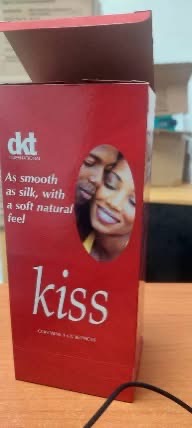
The National Agency for Food and Drug Administration and Control has warned Nigerians against the sale and use of counterfeit Kiss condoms discovered in several markets nationwide, citing grave public health concerns.
In a public alert issued on Monday (Public Alert No. 042/2025) via X, NAFDAC said the information was received from DKT International Nigeria, the marketing authorisation holder for Kiss condoms and a non-governmental organisation involved in contraceptive social marketing.
According to the agency, fake Kiss condoms have been found in Onitsha, Idumota and Trade Fair markets, as well as markets in Kano, Abuja, Uyo, Gombe and Enugu, among others.
NAFDAC explained that Kiss condoms are male latex contraceptives designed to prevent unwanted pregnancies and sexually transmitted infections, including HIV, gonorrhoea and syphilis, noting that counterfeit products undermine their protective function.
To help consumers identify genuine products, the agency said authentic Kiss condom boxes carry clear usage instructions, storage and caution information, complete manufacturer and medical device details, lighter-coloured packaging and a visible condom image.
In contrast, it said fake versions often lack side information, have darker packaging and images, plain white inner boxes, no condom image, incorrect or incomplete manufacturer addresses, and no storage or caution details.
On the packs themselves, NAFDAC noted that original Kiss condoms are light red, with the brand name written closely across six lines, while counterfeit packs are darker, with the name loosely written across five lines and a longer condom strip.
Differences were also observed in the physical features of the condoms. Genuine Kiss condoms are reportedly larger, oval-shaped, better lubricated and have larger teat ends, while fake ones are thinner, rounder, less lubricated and have smaller teat ends.
Warning of the dangers, NAFDAC said the use of counterfeit condoms poses serious health risks due to poor quality, lack of sterilisation and absence of regulation, which could lead to breakage, infections, allergic reactions and false protection against pregnancy and sexually transmitted infections.
The agency said it has directed its zonal directors and state coordinators to intensify market surveillance and remove the fake products nationwide. It also urged healthcare workers and the public to report suspected substandard or falsified medical products to the nearest NAFDAC office.