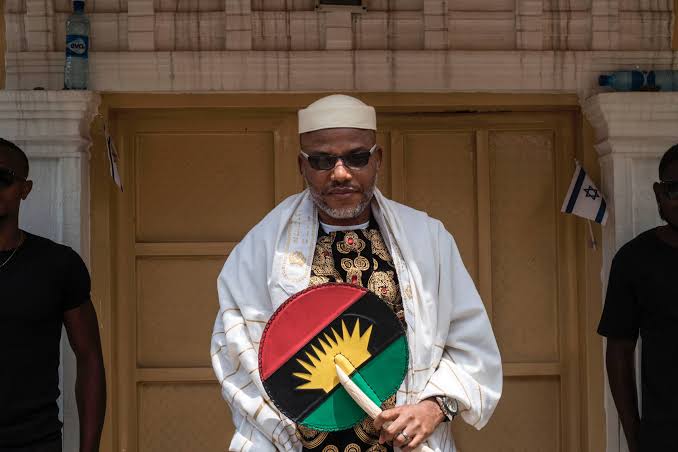
Mazi Nnamdi Kanu, the leader of the Indigenous People of Biafra (IPOB), has raised grave concerns over ongoing injustices he faces, accusing the Nigerian government of executive and judicial fraud since his extraordinary rendition in 2021.
In a public letter addressed to Nigerians, Kanu highlighted numerous instances of legal misconduct, including a 2017 Federal High Court ruling that declared IPOB a lawful organization.
Despite this, the government bypassed the ruling by outlawing IPOB and branding it a terrorist group through a covert and unjust legal process.
Kanu also pointed out the contradictions in the legal system, particularly the 2022 Federal High Court decision that deemed his rendition unconstitutional, followed by the government’s refusal to adhere to judicial decisions and delays in his release.
He expressed frustration with the judiciary’s failure to protect his rights despite several favorable court rulings.
The letter made it clear that Kanu is committed to fighting for his freedom, declaring that he would not accept any trial that bypasses constitutional procedures.
His call for justice highlights broader concerns regarding legal rights, with Kanu refusing to submit to further detention or trial under a system he considers biased and unjust.
In a related development, the Alaigbo Development Foundation (ADF) has called for substantial reparations in recognition of the historical marginalization of the Igbo people, following former President Ibrahim Babangida’s clarification about the 1966 coup.
ADF’s National President, Prof. Ukachukwu Awuzie, demanded ₦100 trillion from the Nigerian government for the development of the South East over the next five years.
The requested funds, ADF explained, would be allocated to restore properties abandoned during the Civil War and to improve infrastructure in the region.
Moreover, the ADF called for the immediate release of Nnamdi Kanu and advocated for the election of an Igbo president as part of efforts to address historical grievances.
The group also insisted on a formal national apology from the government and the establishment of a monument in honor of Professor Humphrey Nwosu, the hero behind the June 12, 1993, election.
Prof. Awuzie commended Babangida for dispelling the myth that the January 1966 coup was an Igbo conspiracy, highlighting how such false narratives contributed to the animosity against the Igbo people and led to atrocities during the Civil War.
He emphasized that, despite their immense contributions to Nigeria’s development, the Igbo people have been politically marginalized and denied fair representation.
The ADF concluded by asserting that the Igbo people’s demand for self-determination is not only a moral right but also a constitutional one. The foundation stressed the importance of addressing these historical injustices to pave the way for a more united and peaceful Nigeria.
Advertisement