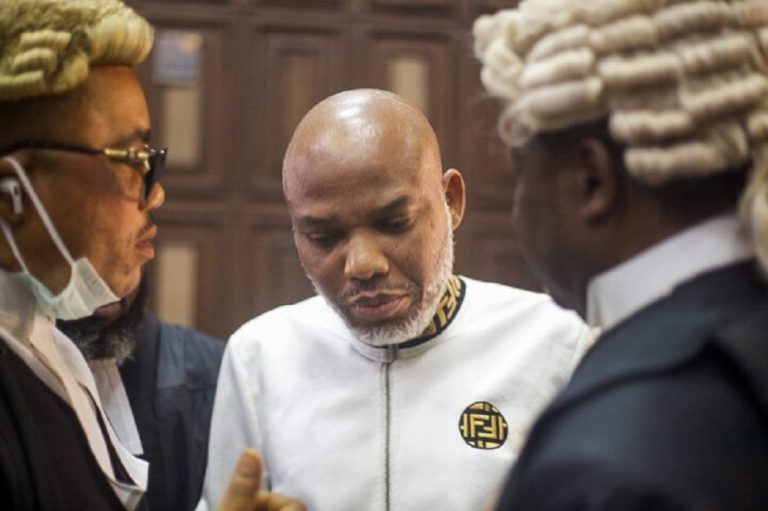
An operative of the Department of State Services (DSS) told the Federal High Court in Abuja on Wednesday that Nnamdi Kanu, the leader of the outlawed Indigenous People of Biafra (IPOB), was treated like a president while in the secret service’s custody.
The court admitted three recordings, one of which showed Kanu inspecting a radio transmitter reportedly smuggled into the nation.
During the resumed hearing of the terrorism trial, Kanu claimed to have produced statements under duress between October and November 2015.
During the trial-within-trial, Mr CCC, the third prosecution witness, denied using threats of solitary confinement to get the defendant to testify.
The defendant alleged that a DSS operative, Mr Brown, threatened them with solitary imprisonment in the ‘dungeon.’
However, the witness stated that the cops who participated in the interrogation were James, Ibrahim, and Collins, with no Mr Brown among them.
Mr. CCC stated that Kanu was given presidential treatment and expressed shock at allegations of using force to get him to make certain statements, including calling Presidents Goodluck Jonathan and Muhammadu Buhari unprintable names and alleging Senator Rochas Okorocha ‘Islamized’ his people.
These are statements he allegedly made when he granted an interview with a US-based online medium known as Sahara Reporters. It was during the same interview that, according to the witness, Kanu used the term ‘Zoo’ to refer to Nigeria.
The contentious items are three written statements made at the DSS Headquarters by Kanu on October 23rd, 24th and November 4th, 2015. These statements along with a video recording of his oral statements of October 21 and 23, 2015 were also tendered.
Justice James Omotosho took the path of trial-within-trial to clear the air on the admissibility or otherwise of the statements the defendant claims were obtained under duress.
In a ruling, the judge said “It is law that whenever an issue of involuntariness is raised, the Evidence Act and the law” requires that an order for trial within trial be made to determine whether a statement was taken under duress or otherwise. He added that establishing duress will therefore make the statement in contention inadmissible.
Justice Omotosho further informed parties in the case that at the end of the trial-within-trial, the court will also rule on how the absence of the defendant’s lawyers affects the case of the defendant.
In the three footage played in court by the prosecution to prove that Nnamdi Kanu made his statements voluntarily, the Biafra nation agitator admitted to being the founder and director of Radio Biafra.
In one of the footage, Kanu claimed that the Biafra cause enjoyed funding across the globe from all those who believe in the ideals of the secessionist agenda. He claimed the group has representatives in over 80 countries.
At some point during trial-within-trial, Kanu took the witness stand to give evidence in his case.
The defendant claimed, in his testimony, that he was struck by a DSS operative when he was picked up in Lagos in 2015. But the same operative later apologised on their way to the airport to Abuja.
Meanwhile, Justice Omotosho has adjourned the matter till Thursday, May 29, 2025, for the continuation of the hearing and to deliver ruling on the admissibility of the statements.
Advertisement