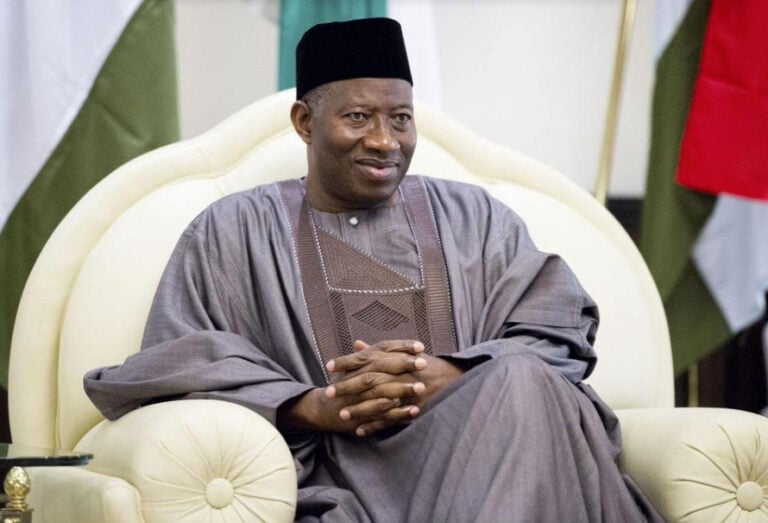
Former President Goodluck Jonathan has attributed his withdrawal from active, partisan politics to his membership in the West African Elders Forum (WAEF).
Speaking in Abuja on Thursday at the 10th anniversary celebration of the Goodluck Jonathan Foundation (GJF), themed “Legacy of Impact, Celebrating Our Journey,” Jonathan explained that WAEF requires strict neutrality from its members. The event also included a gala dinner marking his 68th birthday.
Jonathan told attendees that WAEF operates as a preventive diplomacy body made up of former heads of state who visit countries during election periods to mediate and prevent crises linked to poorly executed polls.
“The idea is to observe elections not as monitors but to intervene early wherever we sense emerging problems, so they don’t escalate into full-blown crises,” he said.
He emphasised that WAEF membership is open only to former presidents within the sub-region who have also led ECOWAS.
“One clear condition is that you can no longer be an active politician. That is why many of my political associates feel disappointed. They expect me to play a more active role, but to do that I would first need to resign from WAEF,” he noted.
On national issues, Jonathan lamented what he called “rascality” in Nigerian politics, urging political actors to adopt more responsible conduct. He observed that, unlike professions that require training and certification, politics often attracts individuals without adequate preparation.
“We must change the face of politics. It should be for responsible people, not something treated like the rough business of a motor park,” he said.
Jonathan also expressed sorrow over the kidnapping of about 25 girls in Kebbi State, recalling the trauma of the Chibok abduction during his administration.
He condoled with families of those killed, including a vice principal, and called for prayers for the safe return of the abducted girls and an end to such tragedies.
Reflecting on how GJF was established after his 2015 election loss, Jonathan revealed that businessman Tony Elumelu urged him to create the foundation.
Although he initially considered focusing on education and poverty alleviation, advisers encouraged him to prioritise areas where he had earned global credibility.
He said democracy and governance became the Foundation’s core focus because of his contributions to strengthening Nigeria’s electoral system and his decision to concede defeat in 2015 before the final results were announced a gesture widely celebrated.
Despite his professional background in environmental protection and Niger Delta issues, he chose to leave those areas to others.
GJF Executive Director, Ann Iyonu, described the anniversary as a moment to reflect on a decade of advancing democratic governance, peace-building, and development across Africa.
She highlighted the Foundation’s work in election mediation, observation missions, policy dialogues, and advocacy, noting that its annual Democracy Dialogue launched in 2021 has become an important continental platform.
“This year in Accra, we explored the theme ‘Why Democracies Die,’ examining the systemic factors weakening democratic resilience in Africa and globally,” she said.
According to Iyonu, the Foundation has helped promote peaceful political transitions, support inclusive governance, combat violent extremism, strengthen trust between citizens and state institutions, and expand Africa’s partnerships on the global stage.
(NAN)
Advertisement