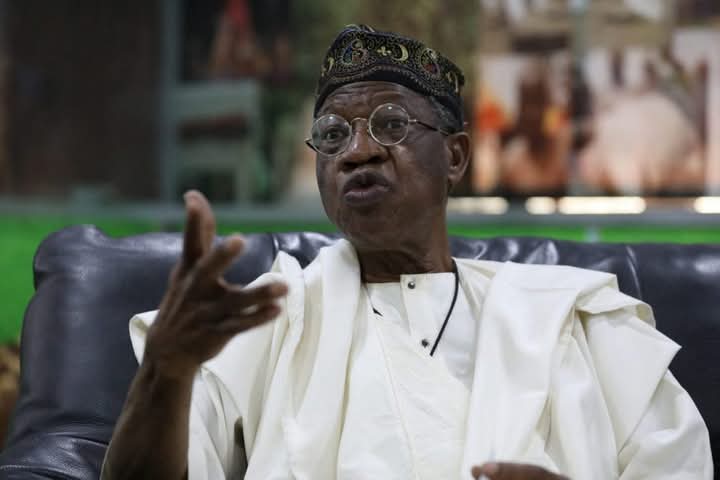
Former Minister of Information and Culture, Lai Mohammed, has described the 2020 #EndSARS protests as the most challenging episode of his time in public office, saying the crisis exposed the dangerous power of fake news and disinformation in Nigeria.
Mohammed made this revelation in his newly released book, Headlines and Sound Bites: Media Moments That Defined an Administration, where he reflected extensively on the nationwide protests and their aftermath.
According to him, although the Federal Government’s decision to suspend Twitter was one of the hardest calls he had to make, nothing compared to the pressure, fear, and uncertainty that followed the #EndSARS demonstrations.
“The #EndSARS saga was undoubtedly the most difficult moment of my tenure as minister,” Mohammed wrote. “It confirmed my worst fears about fake news and disinformation as a clear and present danger to our country. It posed a direct threat to the Buhari administration and, sadly, dragged my innocent family into a crisis they did not deserve.”
The protests erupted in early October 2020 following a viral video alleging police brutality in Delta State. What began as peaceful demonstrations quickly spread across the country, drawing international attention and sparking heated debates online.
Mohammed noted that the speed at which misinformation circulated during the protests highlighted how fake news, hate speech and unchecked narratives could threaten democracy itself.
Reacting to the public outcry, the Federal Government moved swiftly. On October 11, 2020, the then Inspector-General of Police announced the disbandment of the Special Anti-Robbery Squad (SARS). Former President Muhammadu Buhari also promised far-reaching police reforms, assuring Nigerians that security agencies would be repositioned to better protect lives and property.
Despite these steps, the situation deteriorated in several states as violence broke out.
According to Mohammed, security personnel became direct targets during the unrest. He revealed that six soldiers and 37 police officers lost their lives, while nearly 200 policemen were injured. In addition, more than 160 police vehicles were destroyed and 134 police stations were set ablaze.
The violence also claimed the lives of 57 civilians nationwide. Hundreds of private businesses and government facilities were either looted, vandalised, or burnt, while several government warehouses were broken into.
Tensions peaked in Lagos State on October 20, 2020, when Governor Babajide Sanwo-Olu imposed a 24-hour curfew. Mohammed stated that soldiers deployed to the Lekki Toll Gate fired blank bullets to disperse protesters.
However, the situation took a dramatic turn the following day when reports of an alleged massacre at the Lekki Toll Gate began circulating widely in the media.
Mohammed disclosed that the Federal Government almost acted on the reports before verifying the claims. He said it was only after President Buhari contacted the Lagos State governor that it became clear no massacre had taken place.
“I had gone to see the Chief of Staff about observing a minute’s silence for those reportedly killed,” Mohammed recalled. “It was when the President called the Lagos governor that he was informed no such massacre had occurred.”
The former minister was particularly critical of international media coverage of the incident, describing some reports as reckless and unprofessional. He singled out CNN, accusing the network of biased and one-sided reporting.
“How could CNN claim to carry out an investigative report without speaking to a single Nigerian government official?” he questioned, adding that such coverage deepened public confusion and mistrust.
Beyond politics, Mohammed said the disinformation campaign took a heavy personal toll. He revealed that his family became targets of online attacks, harassment and economic sabotage.
“My family bore the brunt of the lies,” he wrote. “They were vilified online, their businesses boycotted, and my son was cruelly labelled ‘the child of a murderer.’ My home address was shared publicly, forcing me to seek security protection.”
Mohammed stressed that history must be guided by facts, not emotions or online hysteria. He maintained that claims of a massacre at Lekki remain unsupported by evidence.
“A massacre leaves behind bodies, grieving families and undeniable proof,” he stated. “None of these exist in the case of the so-called Lekki massacre. There can be no massacre without bodies.”
Lai Mohammed served as Nigeria’s Minister of Information and Culture throughout the two terms of late President Muhammadu Buhari, a position that, he said, gave him a front-row view of the administration’s toughest decisions, controversies and defining moments.
Advertisement