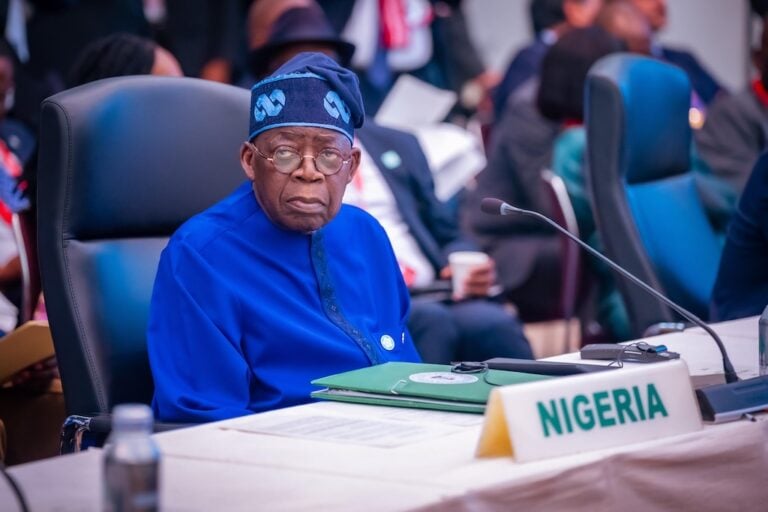
President Bola Ahmed Tinubu has formally requested the approval of the National Assembly to extend the implementation of the 2025 Appropriation Act to March 31, 2026, as part of efforts to end Nigeria’s long-standing challenge of running overlapping budgets.
The request was conveyed in a letter dated December 18, 2025, which was read on Friday during a special plenary session of the House of Representatives by the Speaker, Tajudeen Abbas.
According to the President, the latest request replaces an earlier communication sent on December 16, explaining that the revision became necessary to address persistent gaps and overlaps in the country’s budget execution cycle.
Tinubu noted that the proposed extension forms part of broader fiscal reform initiatives aimed at improving planning, strengthening execution, and enhancing transparency and accountability in public spending.
He explained that the adjustment would enable the Federal Government to fully release at least 30 per cent of capital allocations to Ministries, Departments and Agencies (MDAs), stressing that delayed releases of capital funds have continued to weaken budget performance and slow project delivery across the country.
As part of the proposal, the President is seeking the repeal and re-enactment of the 2024 and 2025 Appropriation Acts, with revised expenditure figures to better reflect current fiscal realities.
Under the new proposal, the 2024 Appropriation Act would be revised upward from N35.05 trillion to N43.56 trillion. The revised figure includes N1.74 trillion for statutory transfers, N8.27 trillion for debt servicing, N11.27 trillion for recurrent (non-debt) expenditure, and N22.28 trillion for capital expenditure and development fund contributions for the year ending December 31, 2025.
Similarly, the 2025 budget, originally approved at N54.99 trillion, would be reviewed downward to N48.32 trillion and extended to cover the period ending March 31, 2026. The revised allocation comprises N3.65 trillion for statutory transfers, N14.32 trillion for debt servicing, N13.59 trillion for recurrent (non-debt) expenditure, and N16.77 trillion for capital expenditure and development fund contributions.
In his letter to lawmakers, Tinubu explained that the bills were designed to accommodate budgetary items previously unrecognised while aligning capital implementation with a revised target of 30 per cent.
He added that the proposed changes reflect Nigeria’s current fiscal capacity and execution realities, while ensuring that budget performance remains credible, transparent and achievable.
The President urged members of the National Assembly to consider and pass the bills expeditiously, stressing that timely approval was crucial to national development and effective fiscal management.
Since assuming office in May 2023, Tinubu’s administration has grappled with overlapping budget cycles, a situation attributed to delayed budget passage, revenue shortfalls and slow release of capital funds.
The Presidency has repeatedly warned that operating multiple budgets simultaneously undermines fiscal discipline, disrupts project planning and complicates accountability across government institutions.
Advertisement