
The All Progressives Congress has begun strategic efforts to consolidate recent defection gains and address internal crises across some of its state chapters ahead of the 2027 general elections.
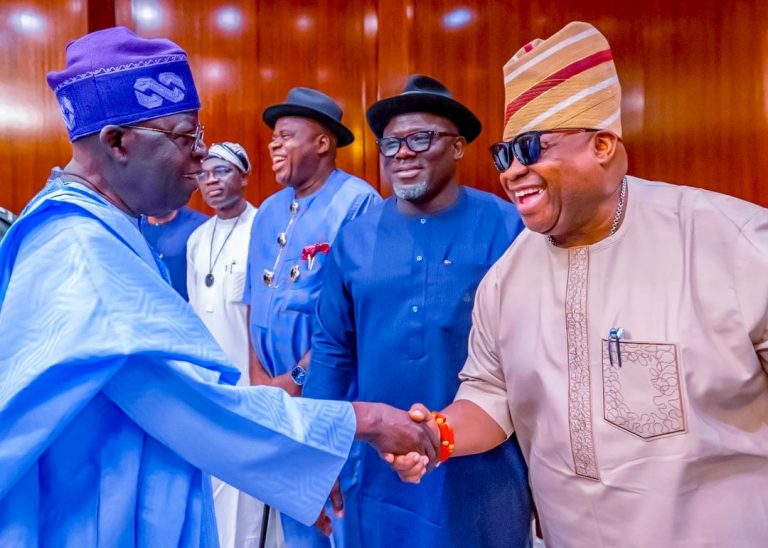
On Wednesday, governors elected on the platform of the ruling party and members of its National Working Committee held a closed-door meeting in Abuja amid intensified political consultations ahead of the party’s national convention scheduled for March.
The meeting took place at the Imo State Governor’s Lodge in Asokoro and was attended by APC governors led by their chairman, Governor Hope Uzodinma of Imo State, as well as NWC members headed by the party’s National Chairman, Nentawe Yilwatda.
Governors present included Caleb Mutfwang (Plateau), Uba Sani (Kaduna), Mohammed Idris (Kebbi), Francis Nwifuru (Ebonyi), Ahmad Aliyu (Sokoto), Ahmed Usman Ododo (Kogi), Hyacinth Alia (Benue), Agbu Kefas (Taraba), Umo Eno (Akwa Ibom), Lucky Aiyedatiwa (Ondo) and Babajide Sanwo-Olu (Lagos), among others.
Party insiders disclosed that discussions at the meeting centred on the APC’s 2027 electoral strategy, with particular focus on managing the influx of defecting governors and their political structures, as well as resolving lingering crises in some state chapters.
According to a senior party official, the leadership acknowledged that while the recent wave of defections has strengthened the APC, it also poses the risk of internal implosion if not carefully managed.
“We have recorded significant successes, with about eight opposition governors joining the party in recent times, many of them bringing along large political followings. The challenge is how to accommodate everyone as preparations for the next elections gather momentum,” the official said.
Another party chieftain revealed that the meeting also addressed disputes in some state chapters, including the protracted crisis in Rivers State.
“The leadership is concerned about resolving internal conflicts ahead of the congresses and the national convention. Rivers State, in particular, remains an issue,” the source added.
The meeting comes amid an unprecedented political realignment ahead of the 2027 polls, with the APC recording its largest wave of defections since assuming power in 2015.
In recent months, at least eight governors elected on opposition platforms have defected to the ruling party, alongside several lawmakers, commissioners and grassroots political structures.
The governors who crossed over include Siminalayi Fubara (Rivers, PDP), Peter Mbah (Enugu, PDP), Sheriff Oborevwori (Delta, PDP), Douye Diri (Bayelsa, PDP), Umo Eno (Akwa Ibom, PDP), Agbu Kefas (Taraba, PDP), Abba Yusuf (Kano, NNPP) and Caleb Mutfwang (Plateau, PDP).
The defections have significantly expanded the APC’s influence nationwide and strengthened its control across federal and state levels, a strategic advantage given the role governors play in mobilising votes and political resources.
However, party sources noted that the development has also triggered fresh tensions in several states, particularly where existing party leaders are resisting the emergence of new power blocs.
Concerns are also mounting over the party’s ongoing electronic registration and revalidation exercise, which is expected to determine delegate strength ahead of ward, local government, state and zonal congresses. These congresses will ultimately shape the composition of the National Working Committee at the March national convention.
With less than two years to the general elections, analysts say the APC leadership is under pressure to harmonise internal interests, manage rival factions and prevent disputes that could undermine its chances of retaining power at both federal and state levels.
Advertisement