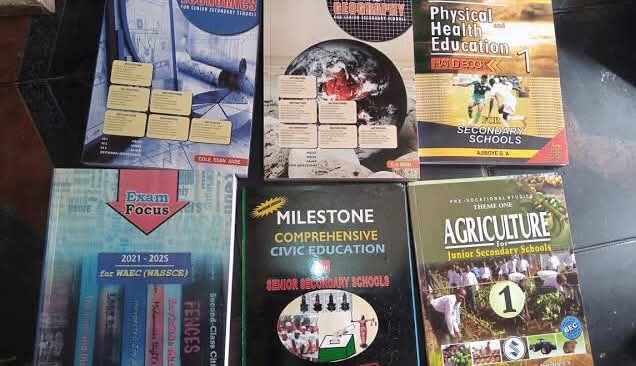
The Federal Government has introduced a new policy aimed at reducing the rising cost of education for parents by promoting the use of durable, reusable textbooks that can last between four and six years in Nigerian schools.
The policy, jointly unveiled by the Minister of Education, Dr Maruf Alausa, and the Minister of State for Education, Prof. Suwaiba Ahmad, is part of ongoing reforms designed to improve learning outcomes, strengthen quality assurance, and promote sustainability within the education sector.
This development was disclosed in a statement on Friday by the Director of Press and Public Relations at the Ministry of Education, Boriowo Folasade.
According to the ministers, the new framework places strong emphasis on the adoption of standardised, high-quality textbooks, while expressly banning the practice of bundling textbooks with disposable workbooks that force students to write directly in them.
“Our goal is to make education both affordable and qualitative,” the ministers said.
“By moving to durable, reusable textbooks, siblings can share learning materials over several years, significantly cutting costs for parents and reducing waste across the school system.”
They explained that the policy is also designed to support environmental sustainability by ensuring that learning materials can be reused across multiple academic sessions.
As part of the wider reforms, the Federal Government has also introduced a uniform academic calendar to ensure consistency in teaching and learning nationwide. In addition, graduation ceremonies have been streamlined to ease the financial burden on families.
Under the new guidelines, only pupils and students in Primary 6, Junior Secondary School 3 (JSS3), and Senior Secondary School 3 (SSS3) will be allowed to hold graduation ceremonies.
“We must clearly separate genuine milestones from routine transitions,” the ministers stated.
“Limiting formal graduations to exit classes will protect parents from the frequent, costly celebrations that have become more of a burden than a celebration.”
The policy further strengthens the assessment, selection, and quality assurance of textbooks and instructional materials used in schools across the country.
Addressing long-standing complaints, the ministers said the government would put an end to frequent but cosmetic textbook revisions that force parents to buy new books every year without any meaningful improvement in content.
“We are ending the era of superficial revisions designed to increase sales rather than improve learning outcomes. Nigerian students deserve instructional materials that meet international standards of quality and durability,” they added.
Under the new framework, textbook revisions must be substantive, reflecting genuine improvements in content rather than minor changes in layout or pagination. The policy also limits the number of approved textbooks per subject and class, in line with global best practices observed in countries such as Japan, Kenya, and Tanzania.
This measure, the ministers noted, will improve quality, reduce market saturation, and make textbook selection easier for schools and education authorities.
The Nigerian Educational Research and Development Council (NERDC) will continue to lead the evaluation and approval of instructional materials, working closely with other education agencies to ensure that only curriculum-aligned, high-quality textbooks are used nationwide.
The Federal Ministry of Education also commended the Universal Basic Education Commission (UBEC), NERDC, and other technical partners for their contributions to the development of the policy.
Reaffirming its commitment to education reform, the government said the policy would help restore the once-common practice of hand-me-down textbooks, which allowed families to pass books from older to younger children, significantly lowering household education costs.
In recent years, this tradition has been undermined by the rise of disposable workbooks, frequent superficial revisions, and school-imposed textbook monopolies, especially in the private sector, which forced parents to buy new materials annually at inflated prices.
The new policy, the government said, is aimed at restoring affordability, protecting parents, and ensuring that Nigerian learners have access to durable, high-quality instructional materials that support effective teaching and learning nationwide.
Advertisement