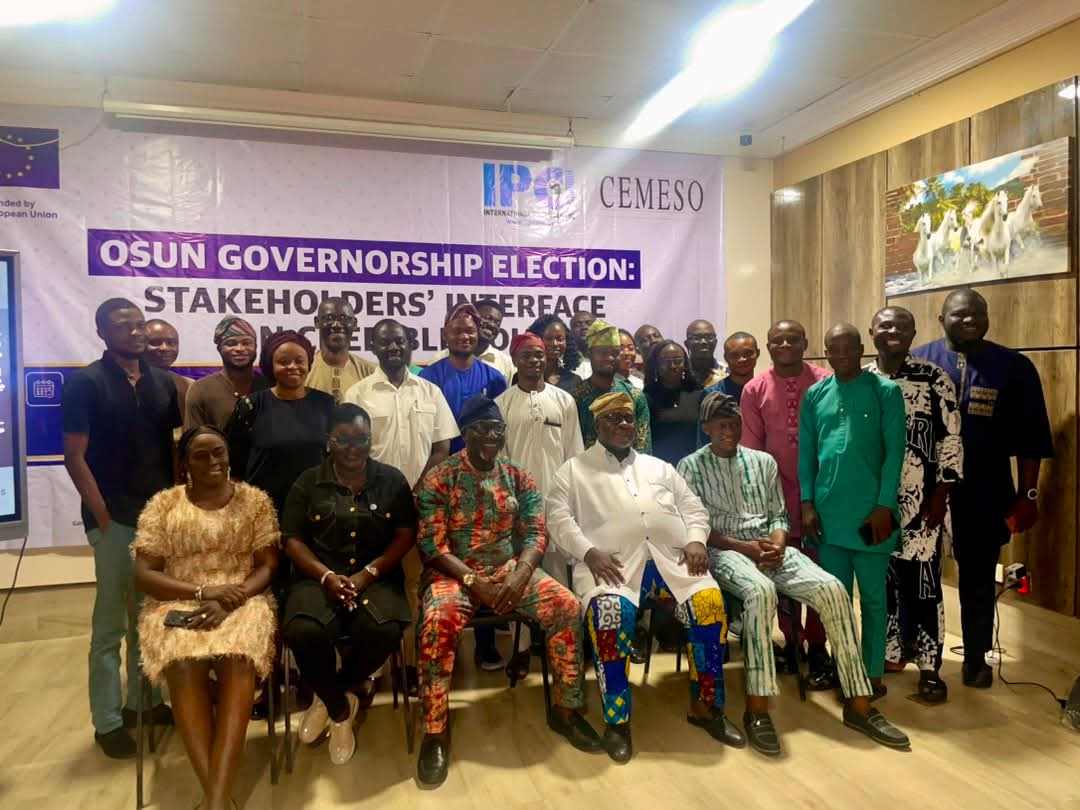
With just thirty nine days to the off cycle governorship election of Osun State, the International Press Centre (IPC), in partnership with the Centre for Media and Society (CEMESO), brought together journalists, election officials, security agencies and other stakeholders in Osogbo to strengthen preparations for a credible poll under the European Union Support to Democratic Governance in Nigeria Phase II (EU-SDGN II) programme.
As one of the participants in the stakeholders engagement, Insightlinks craft out ten key things from the engagement:
1. Osun poll is a major test of Electoral Act 2026
IPC described the election as a crucial test of the Electoral Act 2026, particularly the mandatory electronic transmission of results to the INEC Result Viewing (IREV) portal, ahead of the 2027 general elections.
2. Journalists urged to prioritise fact-checking
Media professionals were advised to verify information before publication and avoid amplifying false or misleading claims capable of undermining the credibility of the election.
3. Misinformation remains a major threat
Stakeholders identified misinformation and disinformation as significant risks to peaceful elections, warning that fake news could fuel tension, discourage voter participation and erode public confidence.
4. Fact-check coalition already debunking false claims
Sodiq Yusuf of the Fact-check Osun State Election coalition under the Insight Initiative for Social and Community Development (IISCD) disclosed that the group has been monitoring election-related narratives and recently debunked claims, including an allegation that Governor Ademola Adeleke sat for the WASSCE at the age of 64. The coalition also verified a viral video involving APC governorship candidate Asiwaju Munirudeen Bola Oyebamiji to provide proper context and counter misleading interpretations.
5. Education and youth empowerment top voters’ priorities
Findings from IPC’s ongoing public opinion poll showed that education and youth empowerment rank among the biggest concerns of Osun residents, alongside rural development and agriculture.
6. INEC, police declare readiness
Representatives of the Independent National Electoral Commission (INEC) and the Nigeria Police Force assured stakeholders of their preparedness to conduct and secure a peaceful, free and credible governorship election.
7. Journalists encouraged to promote issue-based campaigns
Speakers urged the media to focus on policies, manifestoes and governance issues rather than sensationalism, political propaganda or personality attacks.
8. Women, youths and persons with disabilities must not be left behind
The programme emphasised inclusive election coverage, encouraging journalists to amplify the voices and concerns of women, young people and persons with disabilities throughout the electoral process.
9. Civic and voter education remains critical
Stakeholders stressed that sustained voter education is essential to tackling voter apathy, vote-buying and misinformation, while helping citizens understand the electoral process.
10. Fact-checking will continue after the election
According to Yusuf, the Fact-check Osun State Election coalition intends to sustain its work beyond the August 15 governorship poll by monitoring election-related information, expanding fact-checking initiatives and combating fake news to strengthen information integrity in Osun State.
The stakeholders’ interface formed part of IPC’s broader efforts to promote ethical journalism, strengthen media professionalism and support peaceful, transparent and credible elections in Osun State ahead of the governorship poll.