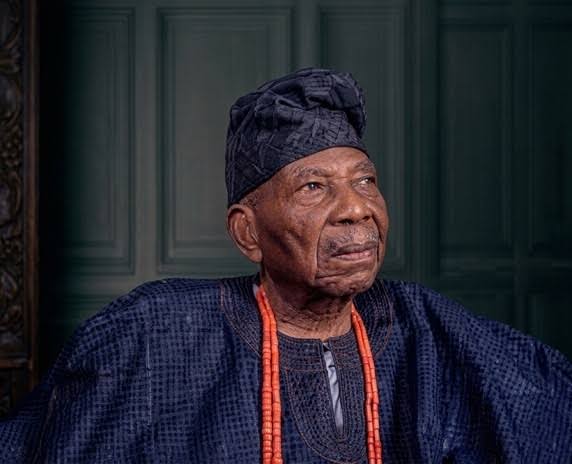
The passing of Afenifere leader, Pa Reuben Famuyide Fasoranti, at 100 closes a chapter in the social, economic and political history of the Oduduwa race. Fasoranti was an embodiment of the renascence triggered by the signing of the 1886 Treaty that ended the bloody civil war which engulfed Yorubaland. That awakening, bringing forth a transformation in every aspect of endeavour across the region, gave the Yoruba a decisive advantage over the rest of the federation. Unfortunately, it has been stalled in recent decades due to leadership resting on its oars.
With the passing of the pillars and embodiments of the renascence, the children of Oduduwa should now look at their intervention on two fronts: how to catch up with the rest of the world and how to define and determine the shape and size of the race in the coming two to three decades of profound uncertainties amid constant changes.
Fasoranti was, among many things, an educationist – notably serving as headmaster of the highly rated Olivet Heights and founding his own quality educational institutions. With his demise, the Yoruba need to return to the foundational roots of our renaissance. In the current anti-intellectual atmosphere, catching up requires rebuilding the foundation and interpretation of education itself. In this way, education can be translated into the base for Research-In-Application, which now constitutes the only survival mechanism for the near and distant future. This is make-or-break, as there is no alternative. Indeed, it confirms the French aphorism that “the more things change, the more they remain the same.”
In addition, if leadership is genuinely interested in the future of the Yoruba race, the six states of the Southwest ought to forge a binding agreement. A dedicated percentage, not less than 2% of combined federal and internally generated revenue, should be deployed – often in conjunction with the private sector – to fund research translated into regional development. This mirrors what India’s former Prime Minister, Jawaharlal Nehru, did for his country as a whole – a foundational policy that remains a key driver in India becoming the world’s sixth-largest economy today.
The leadership in Yorubaland needs to learn from how Nehru put research into development and placed emphasis on the benefits of the economies of scale achieved through regional integration. Childish obsessions with fiefdoms – otherwise referred to as states – have to be phased out. The states are hamstrung by a quasi-federalist structure, and it is only by increasingly and unrelentingly deepening internal integration that a way can be found around these obstructions. This would please the founding fathers. Indeed, a prominent member of the succeeding generation, Bola Ige, constantly affirmed his dislike for the term “Southwest”, always insisting on calling it “Western Nigeria.” This is the spirit that should now be placed at the forefront, for Ige certainly knew what he was talking about.
As Frantz Fanon noted, each generation must, out of relative obscurity, discover its mission, fulfil it or betray it. In order to derive benefits from the transition of Fasoranti and other patriots who preceded him – going all the way back to Adegoke Adelabu (Penkelemesi) – it is very sensible to push forward the spirit of the faithful departed by holding a regional integration conference to work out a blueprint for the unified development of the Western Region up to 2060. This has to be done, for its impact would be akin to achieving exactly what Kiriji and the formation of Egbe Omo Oduduwa achieved.
Look at Brazil! President Luiz Inácio Lula da Silva has just won a historic fourth presidential term, defeating Flavio Bolsonaro in the runoff by 4,430,191 votes. The important takeaway for Nigeria is that Lula is a transformative political figure. Within the confines of a democracy in which he has never for one day controlled the national assembly, he has lifted 20 million people out of poverty, using the Bolsa Família (Family Allowance) programme to help turn Brazil into an economic powerhouse.
Through the Minha Casa, Minha Vida (My House, My Life) initiative, Lula has built 1 million affordable homes a year on a monthly rent-to-own framework. It is important to remember that Nigeria once had a similar scheme through the Lagos Executive Development Board (LEDB), which helped to create a sustainable middle class and built generational wealth in the Lagos Colony and First Republic. We should return to such a programme, and those in Nigeria – and the Southwest in particular – who are genuinely desirous of achieving sustainable development would do very well to take a critical look at the achievements of Lula’s administration. The iconic figures of our past, such as Obafemi Awolowo, Lateef Jakande, and Adelabu, would definitely be proud of Lula’s success and would want our own political establishment to emulate it.
Obafemi Awolowo! Adekunle Ajasin! Abraham Adesanya! Reuben Fasoranti! “Ikú á pa ẹni à ń pè, ikú á pa ẹnití ń pe’ni.” After all, no mortal lives forever! With the passing of “the last of the titans of the Awolowo political tradition”, what next for the Yoruba race, and where next? According to Olawale Oshun, former Chief Whip of the House of Representatives and Chairman of the Afenifere Renewal Group (ARG), what now lies ahead for Afenifere _“is more of questions than answers: Are the younger Turks on both sides of ‘Afenifere Akure’ and ‘Afenifere Ogbo’, many of whom may not critically or appropriately define Afenifere’s ideology, going to allow the necessary rapprochement essential for the unification of Afenifere in full?_
“What are the thought processes within the ARG, a body that obviously attempted to insulate itself from all the brouhaha that emanated from the 2023 contestation between the two factions – more so as that contestation was devoid of the usual social welfare ideological stances of the institution? That is the reason I suggest it is more of questions than answers, and the time for sober reflection and acceptance of the need for unity is now.”
In his own remarks, Afenifere’s Organising Secretary, Kole Omololu, stressed that the group’s defining challenge was preserving its “institutional integrity and Awolowo’s progressive ideals.” Urging _“respect for traditional succession and stability under Oba Olu Falae”,_ Omololu insists that _“partisan loyalties must never take precedence over the collective interests of the Yoruba people”_ in a genuinely federal Nigeria.
Nearly 18 years ago, on January 16, 2009, my article ‘Afenifere: Your deed shall speak you!’ warned of a troubled sociocultural organisation. Today, Afenifere looks somewhat decapitated, having succumbed to the principalities and powers of divisions and distractions, with its culture coloured by factions and fractures. Since we are no longer running a regional government, the question of who becomes the next Yoruba leader relies on an outdated Great Man Theory of History. In truth, the Yoruba are unlikely to rally around a single supreme leader, for they have never been a centralist people to begin with. Even Kiriji was fundamentally a confederal arrangement.
There was a time in Nigeria when Awolowo, as Premier of the Western Region, served as a rallying point for the entire region. He embodied the spirit of transformation from the colonial era to independence. That’s no longer the case now that the region has been split into states. Even President Bola Tinubu, despite his eminence, cannot be regarded in the same mould as Leader of the Yoruba. He is a transient political figure. That is why the race must prepare for the world after Tinubu, lest it come a cropper like a student sitting for an examination unprepared.
May the Stone of Israel rest Chief Reuben Fasoranti’s soul and comfort those the sage left behind!
May the Lamb of God, who takes away the sin of the world, grant us peace in Nigeria!
Email: [email protected]
Mobile: 08033614419 SMS only.