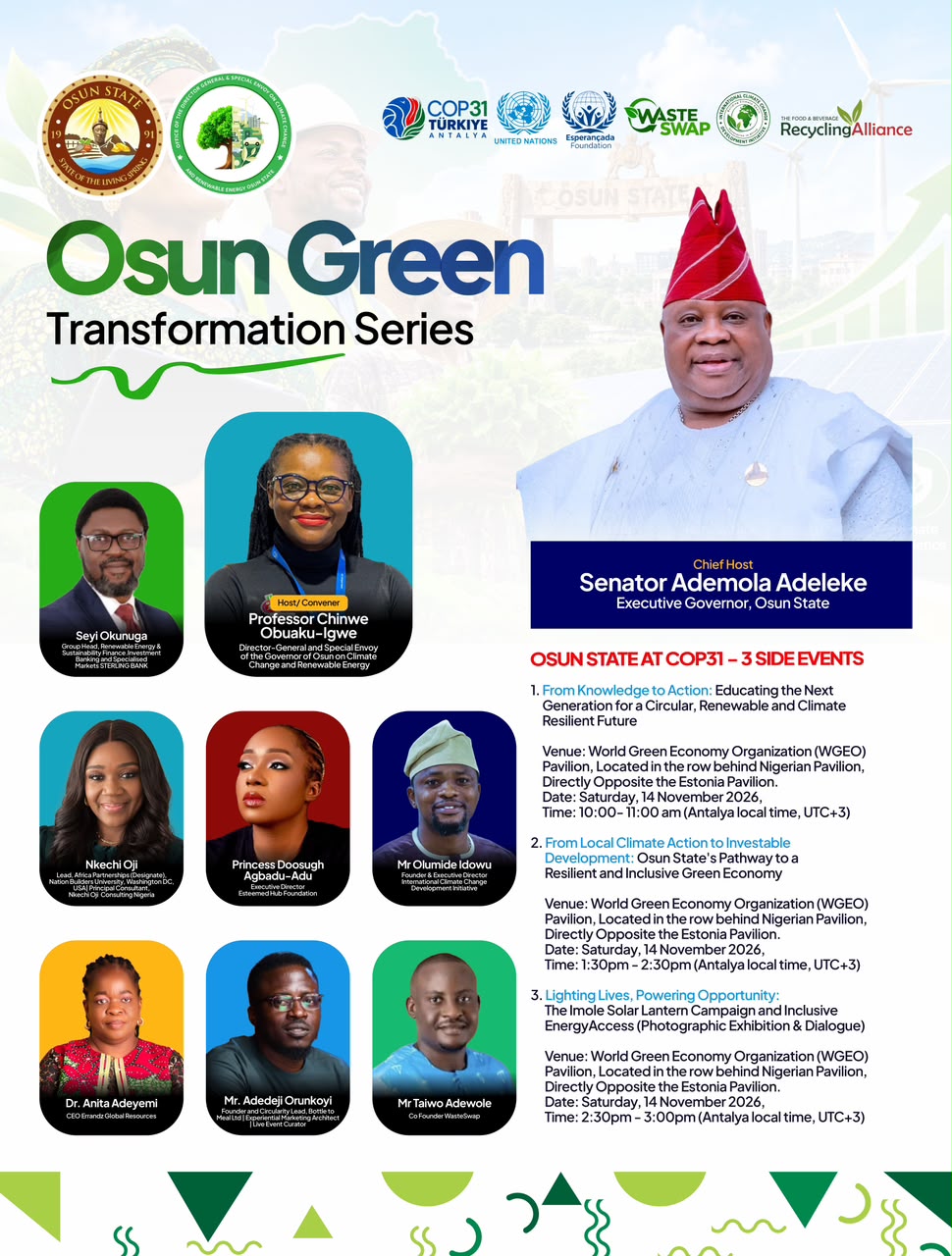
As global leaders and policy makers gather to mark the 31st Conference of Parties, COP31 holding in Antalya in Turkey, Osun State Government will be holding three side events.
Advertisement
According to Professor Chinwe Obuaku, the Director-General and Special Envoy to Governor Ademola Adeleke on Climate Change, the events will serve as avenue to showcase the giant strides of Osun State in Climate change and renewable energy.
The three events will hold on Saturday, November 14, 2026 at the conference venue.
Advertisement
Osun contingent is expected to showcase innovation such as Imole lantern, its investment opportunities and Climate policy of the state.
Advertisement
Read the full article by Professor Chinwe Obuaku:
OSUN STATE AT COP31: FROM LOCAL CLIMATE ACTION TO INVESTABLE DEVELOPMENT
Why subnational climate leadership must move beyond global commitments to practical solutions, inclusive growth and economic transformation.
As world leaders, policymakers, development institutions, climate practitioners and investors converge on Antalya, Türkiye, for the 31st Conference of the Parties to the United Nations Framework Convention on Climate Change (COP31), the question confronting governments is no longer simply how ambitious their climate commitments are, but how effectively those commitments translate into tangible improvements in people’s lives.
It is against this backdrop that Osun State’s participation at COP31 deserves attention.
On Saturday, 14 November 2026, Osun State will take its emerging climate and green economy agenda to the international stage through a series of engagements at the World Green Economy Organization (WGEO) Pavilion, located behind the Nigerian Pavilion. The showcase represents an important opportunity to demonstrate how climate action at the subnational level can become a catalyst for economic diversification, job creation, social inclusion and sustainable development.
What makes Osun’s participation particularly noteworthy is its emphasis on practical interventions rather than climate rhetoric alone.
Under the administration of Governor Ademola Adeleke, the state has increasingly positioned climate governance, renewable energy and the circular economy as complementary instruments for development. This approach recognises that climate change is not merely an environmental concern. It is also an economic, social and developmental challenge that requires coordinated responses across government institutions, communities, businesses and civil society.
One of the highlights of the Osun showcase will be the screening of From Waste to Wealth: A Documentary Journey into Africa’s Circular Economy, alongside the international unveiling of the book Our Planet, Our Responsibility: A Student Guide to Climate Change, Circular Economy, Renewable Energy and Tree Planting, scheduled for 10:00–11:00.
The documentary offers an opportunity to examine how waste, often regarded as an environmental liability, can be transformed into economic opportunity. Through recycling, resource recovery, enterprise development and community participation, the circular economy provides an alternative development pathway capable of creating livelihoods while addressing the growing challenge of waste management.
For a state like Osun, where unemployment, urban waste management and economic diversification remain important development considerations, this approach carries considerable significance.
The state’s circular economy interventions have sought to place young people and women at the centre of this transition, demonstrating that environmental responsibility can also create opportunities for entrepreneurship, skills development and employment.
Equally important is the decision to bring climate education into the conversation.
The international unveiling of Our Planet, Our Responsibility reflects a recognition that the transition to a sustainable economy cannot be achieved through government policies and international agreements alone. It requires informed citizens, environmentally conscious communities and a generation of young people equipped to understand and participate in the green transition.
By introducing climate change, renewable energy, circular economy principles and tree planting to students in accessible language, the initiative addresses a critical gap in climate literacy.
Its significance extends beyond the publication of a book. It is about creating a culture of environmental responsibility within schools and encouraging young people to become active participants in shaping the future of their communities.
Another important component of the Osun presentation is the Imole Solar Lantern initiative, which will be showcased through a curated photographic story titled Lighting Lives, Powering Opportunity, scheduled for 14:30–15:00.
The initiative illustrates the relationship between renewable energy access and everyday development outcomes. More than 10,000 solar lanterns have been distributed through the campaign, highlighting the potential of decentralised clean energy solutions to improve access to lighting, support education, enhance household welfare and reach underserved communities.
For students who struggle with inadequate electricity, households with limited access to reliable power and communities underserved by conventional energy infrastructure, relatively simple renewable energy interventions can make a meaningful difference.
This is an important dimension of climate justice: ensuring that the benefits of the energy transition are not restricted to major cities, large corporations or wealthy households.
Beyond these practical interventions, Osun’s engagement at COP31 will also draw attention to its Climate-Smart Investment Portfolio, an initiative that seeks to move climate ambition towards implementation by identifying projects capable of attracting private-sector participation, development finance, technical partnerships and institutional investment.
This may ultimately be the most consequential dimension of the state’s international engagement.
Climate action requires financing. Governments cannot deliver the scale of transformation required through public budgets alone. They must develop credible investment pipelines, strengthen institutional frameworks, establish partnerships and create the conditions under which private capital can support sustainable development.
For Osun, the challenge is to demonstrate that climate-smart development can be both environmentally responsible and economically viable.
The state’s emerging portfolio provides an opportunity to connect its renewable energy, circular economy, sustainable agriculture, climate resilience and green enterprise ambitions with institutions and investors interested in supporting practical projects at the subnational level.
This is particularly relevant for Nigerian states seeking alternative pathways for economic growth in an increasingly climate-conscious global economy.
Indeed, one of the most important lessons from the global climate process is that national commitments must eventually find expression in local institutions, communities and development programmes. State governments are often better positioned to understand local vulnerabilities, identify opportunities and coordinate interventions that directly affect citizens.
However, international visibility must be accompanied by institutional discipline. The real measure of Osun’s climate leadership will not be the number of conferences attended or presentations delivered, but the quality of projects implemented, the investments mobilised, the jobs created, the communities reached and the measurable improvements in environmental and social outcomes.
COP31 therefore presents Osun with both an opportunity and a responsibility. The opportunity is to attract partnerships, technical expertise, investment and international recognition for a developing subnational green economy agenda. The responsibility is to ensure that the conversations in Antalya translate into sustained action back home.
Nigeria’s climate transition will not be delivered by the Federal Government alone. Its success will depend significantly on the willingness and capacity of states to develop credible climate institutions, integrate sustainability into economic planning and create enabling environments for green investment.
Osun’s participation offers a useful illustration of what this transition could look like when environmental governance is connected to education, enterprise, energy access and economic opportunity.
Ultimately, the significance of Osun at COP31 should not be measured simply by its presence in Antalya. It should be measured by its ability to demonstrate that local climate action can produce global relevance, that environmental responsibility can generate economic value, and that subnational governments can become credible partners in building a more resilient and inclusive future.
The message from Osun is clear: climate ambition must become development action, and development action must become investable opportunity.