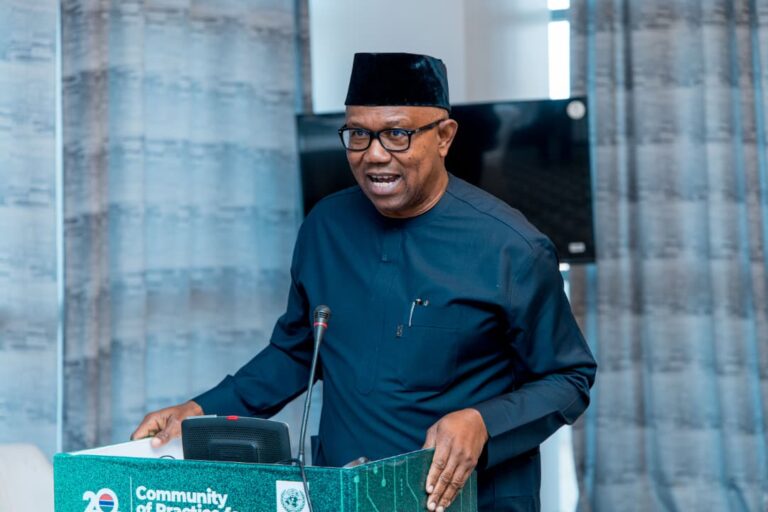
The Nigeria Democratic Party Presidential candidate, Peter Obi has formally kicked off his 2027 campaign, using the occasion to throw down a challenge to his fellow contenders.
Obi made the declaration during a press conference at his Onitsha residence on Friday.
He said “No candidate should hide behind the high walls of power, send proxies or surrogates to the hustings, and expect Nigerians to entrust them with the leadership of the country,” he said.
“Every candidate seeking the presidency must have the courage to come before the people, answer their questions, defend their records, and subject their vision to public scrutiny.”
For Obi, leadership isn’t something that can be exercised from a distance. He argued that genuine leaders need to physically show up, especially in communities battered by banditry, terrorism and flooding to truly understand what people are going through.
“True leadership requires presence and empathy. No one can lead from the front without standing with communities across Nigeria devastated by banditry, criminality, terrorism, and flooding. You cannot truly lead people you are unwilling to visit, listen to, and understand,” he said.
The former Anambra governor, running alongside Senator Rabiu Kwankwaso, said the two of them intend to take their campaign directly to Nigerians nationwide rather than relying on surrogates, promising to listen, engage, and stay grounded in people’s realities.
He framed the 2027 election as a chance for Nigerians to weigh the records and ideas of everyone in the race, at a time when the country is grappling with serious economic and security pressures. His guiding message, he said, is simple: “Nigeria can work, and Nigeria must work.”
Obi ran through a list of the country’s biggest challenges from poverty, food insecurity, displacement, joblessness, weak infrastructure, unreliable power, insecurity to the high cost of doing business but insisted none of it is beyond fixing, given Nigeria’s people, resources and market potential.
Central to his pitch is a shift away from an economy built on consumption toward one built on production. “Nigeria cannot import its way to prosperity. We will produce more of what we consume, process more of what we produce, and compete more effectively in global markets,” he said, pointing to agriculture, manufacturing, technology, construction, energy, the creative sector and services as priority areas, alongside efforts to ease the regulatory and infrastructure burdens holding businesses back.
On government spending, he said every naira should be tied to a clear purpose, with major public investments expected to show measurable results.
Security featured heavily in his remarks too. Obi argued that no economy can thrive when citizens can’t farm, trade or move around safely, and called for better intelligence-sharing between security agencies, stronger policing, tighter border control, and greater use of technology alongside community-based early-warning systems.
He also touched on education and health, pledging to strengthen schools and universities, expand technical and vocational training, improve maternal and child healthcare, and widen access to essential medicines, all of which he tied back to the country’s long-term productivity.
Obi laid out a region-by-region vision for the country’s economic development: agriculture, livestock and agro-processing for the North-West; reconstruction alongside agriculture and enterprise for the North-East; food production and responsible mineral development for the North-Central; manufacturing, tech, finance and the creative economy for the South-West; entrepreneurship and industry for the South-East; and oil, gas, maritime and fisheries backed by stronger environmental safeguards for the South-South.
“Every region must produce. Every region must contribute. Every region must benefit,” he said.
He urged Nigerians to scrutinise every candidate’s record and proposals, ask tough questions, and demand evidence rather than take promises at face value. He also called for a campaign season free of hate and violence, insisting his own campaign would stay focused on the issues rather than ethnicity or religion.
“Nigerians must reject and disregard any campaign driven by propaganda, ethnicity, religion, elitism, or cronyism,” he said. “My ultimate objective is to unite the country, defeat insecurity, reduce poverty and hunger, tackle the problem of out-of-school children, improve education and healthcare and create an economy that works for all Nigerians. A New Nigeria is possible.”
Advertisement