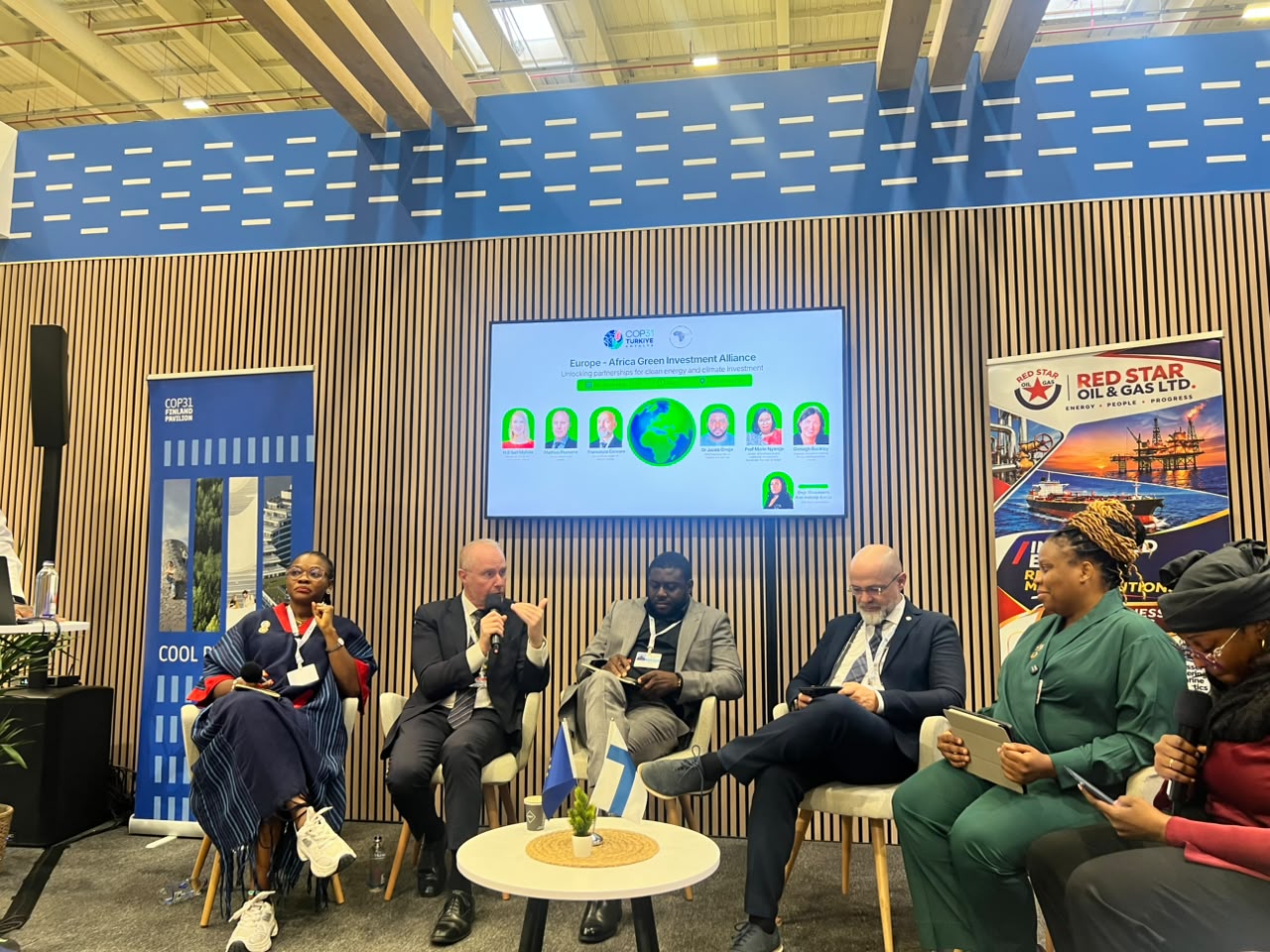
As part of push towards driving investments into the state, Osun State government has opened a new window of engagement with European climate and investment stakeholders at the ongoing United Nations Climate Change Conference (COP31) in Antalya, Türkiye.
The discussion followed a high-level engagement on clean energy investment, waste-to-energy development and renewed European interest in African carbon markets at the conference.
Speaking at a high-level panel on “Europe-Africa Green Investment Alliance: Unlocking Partnerships for Clean Energy and Climate Investment” held at the Finland Pavilion, Prof. Chinwe Obuaku-Igwe, Director-General and Special Envoy of the Governor of Osun State on Climate Change and Renewable Energy, presented the state’s emerging green economy priorities and investment opportunities.
In her contribution to the discussion, Prof. Obuaku-Igwe made a case for moving Europe–Africa climate cooperation beyond policy declarations and diplomatic commitments towards practical investment partnerships capable of delivering economic transformation, employment, energy access and sustainable development.
Drawing on Osun State’s climate governance reforms and growing portfolio of circular economy and renewable energy initiatives, the Governor’s Envoy highlighted the investment potential of converting agricultural residues and organic waste into valuable economic resources.
A statement by the media unit of her office revealed that Obuaku-Igwe had an engagement with Oonagh Buckley on opportunities for waste-to-energy development and the introduction of appropriate economic incentives to encourage farmers to rethink the value of agricultural waste.
“The discussion explored how agricultural residues, which are often discarded or underutilised, could become important inputs for bioenergy generation, resource recovery, circular production systems and rural enterprise development.
“Prof. Obuaku-Igwe emphasised the importance of creating economic incentives and viable market structures that would enable farmers to participate in emerging green value chains rather than treating agricultural waste solely as an environmental disposal challenge,” the statement said.
Europeans Interested In Africans Carbon Credits
Another important development from the engagement was the discussion on the potential for renewed European participation in African carbon markets.
During her exchange with Prof. Obuaku-Igwe, Oonagh Buckley indicated an interest in resuming the purchase of carbon credits from Africa, raising prospects for further engagement on the development and financing of credible African carbon projects.
The discussion presents a potential opportunity for Osun State to explore international carbon finance as an additional source of investment for eligible climate projects, particularly in renewable energy, waste management, methane avoidance, sustainable agriculture and ecosystem restoration.
However, translating this interest into actual investment will require credible project development, robust carbon accounting, independent verification, transparent governance and appropriate benefit-sharing arrangements.
“For Osun State, the opportunity is particularly relevant as the government continues to advance its climate governance architecture, renewable energy agenda and circular economy programmes.
Positioning Osun For Europeans Green Investment
The engagement also provided an opportunity to highlight the importance of sub-national governments in the Europe–Africa green investment agenda.
Prof. Obuaku-Igwe noted that state governments are critical to translating international climate commitments into implementable projects because they work directly with communities, local enterprises, farmers, infrastructure providers and development institutions.
Osun State has been advancing a number of initiatives in this direction, including its ten-year Climate Action Plan, Climate-Smart Investment Portfolio, Circular Economy Action Plan, Renewable Energy Development and Regulation Policy 2025–2040, and programmes supporting youth and women in waste-to-wealth enterprises.
Through its circular economy interventions, the state has also supported the development of green enterprises, recycling initiatives and employment opportunities, while its Imole Solar Lantern Campaign has expanded access to clean lighting.
These initiatives form part of a broader ambition to position Osun as an emerging sub-national destination for green investment, climate innovation and sustainable enterprise development.
Following the discussions in Antalya, the Office of the Director-General and Special Envoy is expected to pursue structured engagements with relevant European institutions and prospective investment partners.
Priority areas will include the preparation of an Osun Waste-to-Energy and Agricultural Waste Investment Concept, exploration of farmer incentive mechanisms, technical discussions on carbon market opportunities and the identification of European partners capable of supporting project preparation, technology transfer and investment mobilisation.
The opportunities will also feed into the proposed Osun State Bankable Green Investment Pipeline, which seeks to translate the state’s climate and sustainability priorities into investment-ready projects supported by technical assessments, financial models and clearly defined implementation arrangements.
The engagement signals an important direction for Osun State’s international climate diplomacy: connecting global climate discussions with practical investment opportunities that can generate economic value at home.
As Africa and Europe explore new pathways for climate cooperation, Osun State is positioning its green economy agenda within that conversation, with a focus on turning environmental challenges into economic opportunities, attracting investment and creating sustainable livelihoods.
The message from Antalya is clear: Africa’s green transition must not only be financed; it must also create jobs, build enterprises, strengthen local economies and deliver tangible benefits to the people.