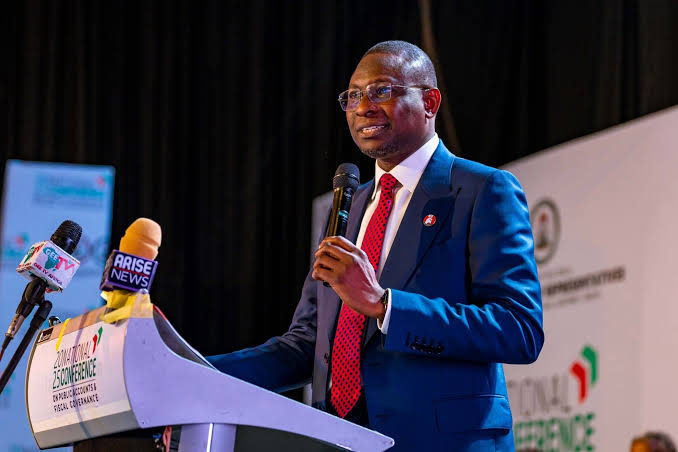
The Chairman of the Economic and Financial Crimes Commission, Ola Olukoyede, has assured Nigerians that proceeds and assets recovered by the commission will be properly accounted for, insisting that none will be mismanaged under his watch.
Olukoyede said the focus should not be on creating another agency to manage recovered assets but on ensuring that every government institution involved in asset recovery is transparent about what it recovers and how such assets are handled.
The EFCC chairman stated this on Tuesday in a post on his X account while responding to the ongoing debate over the management and disposal of forfeited assets.
Olukoyede, who previously served as Secretary of the commission and was directly involved in asset management, said his position was based on practical experience.
“I have followed the debate on managing forfeited assets closely. I am not a commentator on this, I am a practitioner. As Secretary of the EFCC, I managed assets for years,” he said.
He rejected calls for the establishment of a single agency to manage all assets recovered by government agencies, arguing that the sheer volume of recoveries across the country would make such an arrangement difficult to operate.
According to him, more than 20 statutory agencies recover assets on behalf of the government, making it impractical for one institution to take custody of all forfeited properties and proceeds.
He cited the Police as an example, noting that the force has divisions across local government areas and stations in many wards, where assets may be recovered and forfeited.
Olukoyede also referred to previous attempts in other countries to establish centralised asset-management systems, as well as the experience of the Asset Management Corporation of Nigeria, AMCON, which he said resulted in significant financial losses.
Rather than creating another institution, the EFCC chairman said the Proceeds of Crime Act provides a framework that places responsibility on each recovering agency to account for its activities.
“POCA got it right by placing the duty on each agency: what did you recover, and what have you done with it?” he said.
Olukoyede said the EFCC had adopted measures aimed at ensuring that recovered assets and proceeds are properly documented and accounted for.
He said the commission publishes information on its recoveries on its website and submits its annual report to the National Assembly.
“My pledge to Nigerians: not a pin nor a penny of recovered assets will be mismanaged under my watch,” he stated.
The chairman’s assurance comes amid growing public interest in what happens to money, properties and other valuables recovered from suspected proceeds of crime after court-ordered forfeiture.
At a briefing in Abuja last week, Olukoyede disclosed that the EFCC had secured interim and final forfeiture orders covering 10,053 tangible assets since he assumed office.
The assets include real estate, vehicles, plots of land, schools, factories, hotels, oil rigs, barges, machinery and aircraft, as well as 102 tonnes of solid minerals.
He also revealed that the commission had generated about N12.07bn from the disposal of finally forfeited assets, with the proceeds paid to the Federal Government.
According to him, the EFCC recovered more than N1.23tn, $684.48m, £373,905.78 and €9.34m between October 2023 and June 2026, while N661.32bn and $492.37m had been released to beneficiaries.
The figures highlight the scale of assets and funds passing through the commission’s recovery process and, consequently, the importance of transparency in their management and disposal.
Olukoyede therefore challenged other government agencies involved in asset recovery to adopt the same principle of accountability by clearly stating what they recover and what happens to those assets afterwards.
He maintained that strengthening existing accountability mechanisms would be more effective than creating a new central agency to take over assets recovered by different government institutions.