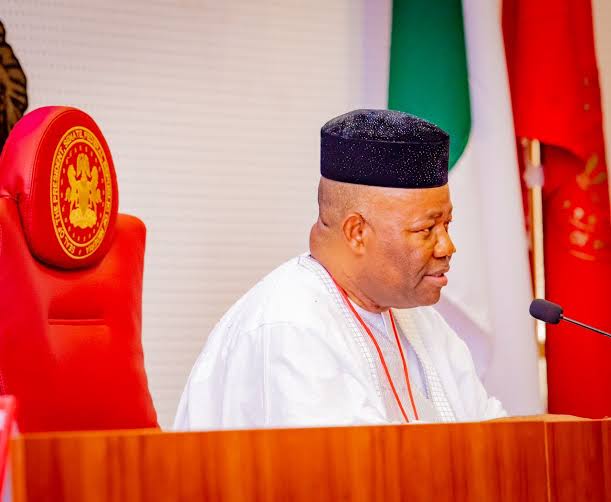
Senate President Godswill Akpabio has revealed that fewer than 30% of Nigerians contribute to the Federal Government’s tax revenue, yet many citizens demand improved infrastructure, education, and security, among other services.
Akpabio made the statement on Monday during the opening of a public hearing on the tax reform bills submitted to both chambers of the National Assembly on October 3, 2024, by President Bola Tinubu. He emphasized that the reforms are crucial, as the country cannot continue with the same approach without progress.
He further stated that once the bills are passed, the National Assembly would strengthen its oversight to ensure resources are used effectively.
Akpabio encouraged the public hearing to serve as a platform for envisioning a better Nigeria. He added that he would participate in the process for two days, expressing his frustration with social media, and criticized many leaders who comment on the bills without reviewing their contents.
The Senate President urged participants and Nigerians to thoroughly review the bills rather than relying on social media opinions.
Among the attendees at the hearing were Minister of Finance and Coordinating Minister of the Economy, Wale Edun, Attorney-General of the Federation, Lateef Fagbemi (SAN), Chairman of the Federal Inland Revenue Service, Zacch Adedeji, and Comptroller-General of the Nigeria Customs Service.
In his opening remarks, Senator Sani Musa (APC, Niger East), Chairman of the Senate Committee on Finance, highlighted that the Joint Revenue Board Establishment Bill and Nigerian Revenue Services Bill would be discussed shortly.
He mentioned that 71 different stakeholder groups had been invited to the hearing, adding that both the Senate and the House of Representatives had completed the second reading of the reform bills and were now ready for public input.
Musa explained that the committee members had reviewed the bills and understood their aims, particularly in areas such as tax administration, collection, and operations in Nigeria.
He stressed that the core objective of the bills is to increase government revenue, which would help position Nigeria as an advanced economy with well-developed infrastructure, education, and agriculture, among other critical sectors.
The tax reform bills under consideration include (i) The Nigeria Tax Bill (NTB) 2024 (ii) The Nigeria Tax Administration Bill (NTAB) 2024 (iii) The Nigeria Revenue Service (Establishment) Bill (NRSEB) 2024 (iv) The Joint Revenue Board (Establishment) Bill (JRBEB) 2024.
The bills passed their second reading in the Senate on November 28, 2024, and have been forwarded to the Committee on Finance for further legislative consideration during Monday’s public hearing.