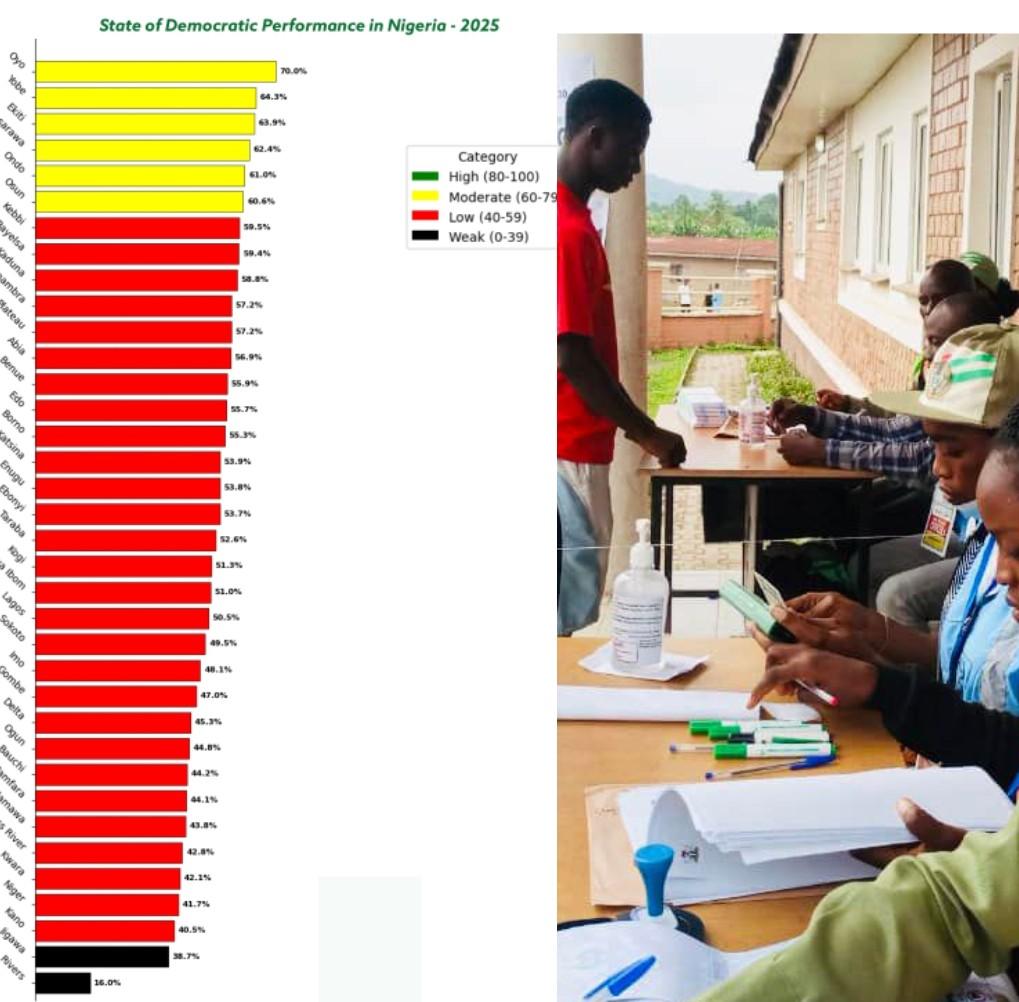
Oyo comes first as Rivers, Jigawa have worst democratic system among 36 states
Osun state has been ranked as 6th state with active democratic system in Nigeria.
The ranking was contained in the recently launched State of Democratic Performance Index by the Kimpact Development Initiative, an Abuja-based civil society organization.
Leading the index was Oyo state, while Yobe, Ekiti, Nasarawa and Ondo came 2nd, 3rd, 4th and 5th respectively.
Announcing the scores, the organisation said Oyo state scored 70.0%, Yobe scored 64.3%, Ekiti had 63.9%, Nasarawa scored 64.4%, Ondo has 61.0% and Osun garnered 60.6%. The six states were graded moderate.
Although no state ranked in the high (80 – 100), 28 states have low performance while Jigawa and Rivers states have weak rating as they scored less than 40%.
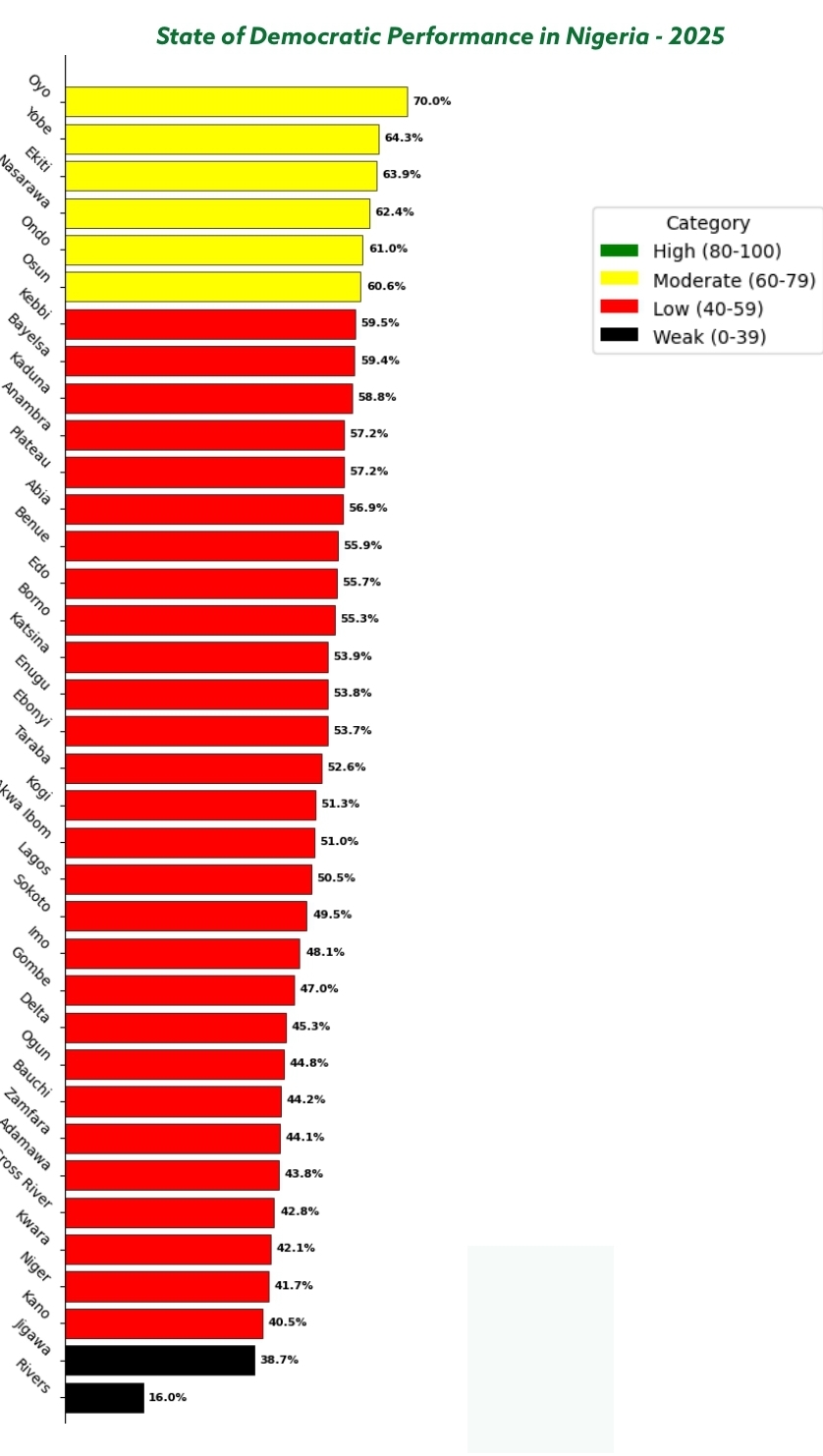
How States were ranked
Speaking at the unveiling held in Abuja recently, the Team Lead of Kimpact Development Initiative, Bukola Idowu said the data cuts across electoral participation, political inclusion, democratic institutional effectiveness and civil liberties and civic space.
He said the team collected data from states’ institutions stating that, ‘’ Institutional data was collected through a structured checklist completed for each state using official records. These include electoral data from INEC and State Independent Electoral Commissions (SIECs), state houses of assembly records, court rulings, budget documents, official government publications, and reports from civil society organisations and media archives.
“Perception data was generated through structured surveys capturing the experiences and views of citizens and relevant stakeholders across all states. The survey adopted a purposive stratified sampling approach to ensure representation across key governance actors.
“A total of 7,128 respondents were engaged across Nigeria, stratified across twelve categories, including citizens, media professionals, state and federal security agencies, civil society organisation leaders, political party officials, the state judiciary, appointive officials (commissioners and special advisers), SIEC staff, LGA staff, and state civil servants. Efforts were made to ensure geographic spread and diversity across gender and age groups within each state. This sample captures informed perspectives from individuals directly engaged with democratic processes. Findings from the survey were therefore interpreted as reflective of stakeholder experience rather than general population estimates.”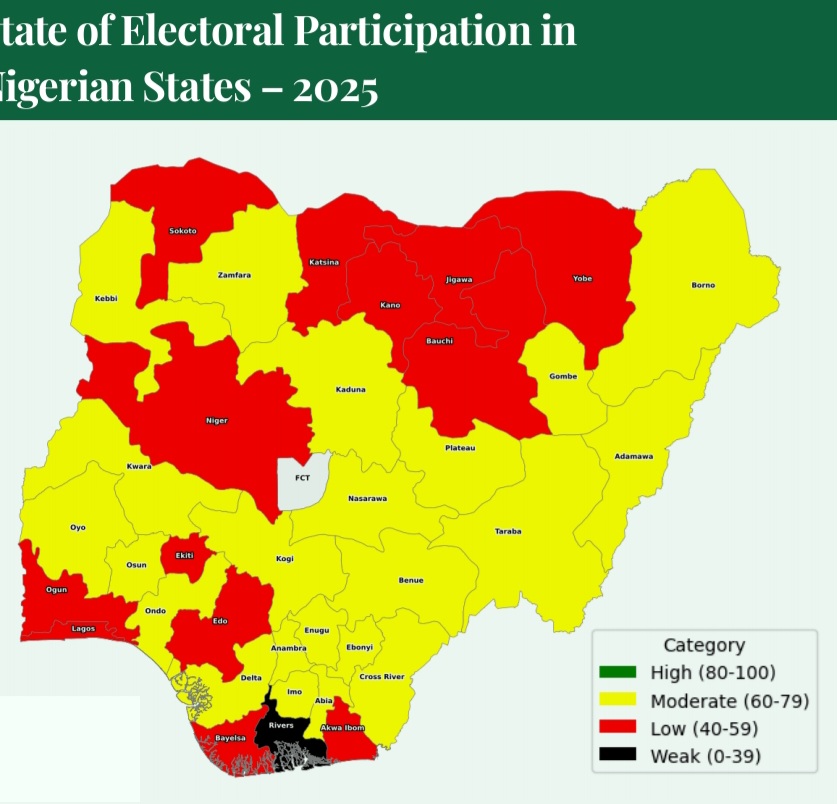
Osun came 6th among 36 states
Speaking on Osun the researchers said the state has strong electoral participation and informed citizens who have vested interest in political atmosphere of the state.
The report reads, “Osun ranks among the leading states in democratic performance, anchored by strong electoral participation. The state demonstrates a politically active electorate, with participation levels that outperform most peers. This engagement extends beyond turnout to a broader sense of democratic depth, where citizens remain invested in political processes.”
The report however, decried the inability of the strong engagement to transform into policy formulation and service delivery.
“However, this strength does not translate evenly across the system. Institutional performance remains comparatively weak, and representation does not reflect the diversity implied by the participation figures. The result is a system where citizens engage actively, but governance structures struggle to convert that engagement into institutional outcomes. The imbalance between participatory energy and institutional capacity defines Osun’s democratic profile,” the report said.
Key deficiencies in Osun
The report also decried lack of inclusion in the governance system, stating that only two of 25 commissioners are women, while none is a youth. It should be noted that the current Assembly has no female among it 26 members.
It also expressed worry over poor institutional performaces, most especially, the absence of key data at the House of Assembly, State Independent Electoral Commission, among others.
The report said, “Osun performs strongly in political inclusion, with a score of 50.00% and a national rank of 4th, suggesting relatively broader access to political space compared to many states. However, this inclusiveness does not fully extend into executive representation.
“Women occupy 2 of 25 commissioner positions, while youth and persons with disabilities are absent, indicating that inclusion is more visible at the electoral stage than within governance structures. Institutional performance remains a constraint, with a score of 49.17% and a ranking of 23rd, placing Osun below its participation and inclusion performance. While the absence of legislative sitting data limits granular assessment, other indicators point to moderate rather than robust institutional functionality. Transparency gaps—such as the citizen budget portal referencing documents that are inaccessible—reflect implementation failures rather than policy absence. Validation participants repeatedly noted that institutional weakness in Nigerian states often manifests through execution gaps, a pattern that Osun’s transparency indicators clearly reflect.”
The report also highlighted strong citizens engagement and political awareness.
Recommendations
In its recommendation, KDI called on Osun government to initiate institutional reforms that would address the lapses observed, most especially, in the procurement process and legislative-executive relationship.
The organisation also advised the civil societies to expand budget tracking initiatives to include local government areas and “link citizen engagement to fiscal accountability”.
The report also urges political actors to “improve governance-policy linkage. Voter engagement is high, but policy delivery gaps risk long-term disengagement.”