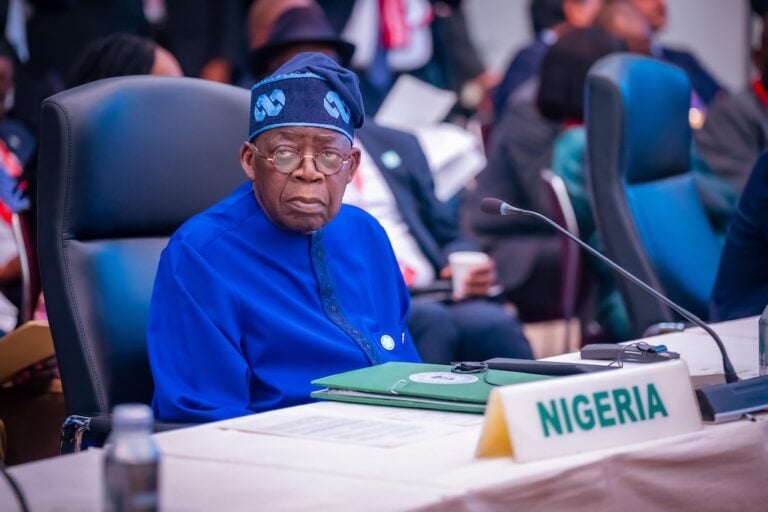
President Bola Tinubu has said his administration’s economic reforms are laying the foundation for Nigeria to overcome decades of underperformance, insisting that the country must translate its vast resources into improved living standards and sustainable prosperity.
Tinubu spoke on Monday through Vice-President Kashim Shettima at the 32nd Nigerian Economic Summit in Abuja, where he defended the government’s economic policies and called for greater productivity across the country.
The President said his administration took difficult decisions at the beginning of its tenure to address longstanding structural challenges that had constrained economic growth, adding that meaningful progress required a break from the practices of previous years.
“There is no shortcut to economic growth,” he said, describing the reforms as a necessary economic reset aimed at creating a stronger foundation for national development.
“We came to rewrite the story of a nation that has performed below its potential for far too long,” Tinubu added.
He explained that the government’s objective went beyond improving economic statistics, stressing that the ultimate test of its policies would be their impact on ordinary Nigerians, particularly jobseekers, farmers, manufacturers, entrepreneurs and innovators.
“For us, rescuing the economy means rescuing livelihoods and transforming the fortunes of young jobseekers, farmers, manufacturers, entrepreneurs and innovators,” he said.
Tinubu argued that stabilising the economy was essential to taking advantage of Nigeria’s growing population, human resources and natural wealth. He said the government was working to create an environment in which businesses could invest, expand and generate productive employment.
The President acknowledged that the next phase of the reforms would require greater emphasis on productivity, better-quality jobs and the effective use of the country’s workforce.
“Our pursuit of prosperity demands greater productivity from every worker, enterprise and investment,” he said.
He added that infrastructure projects should be judged by the economic activities they generate, while the education sector should be assessed by its ability to equip Nigerians with relevant skills and improve productivity.
Tinubu also highlighted the need for industrial policies to strengthen local businesses, attract investment, promote technological advancement, increase exports and create jobs.
To support his administration’s position, the President cited figures from the National Bureau of Statistics showing that Nigeria’s inflation-adjusted Gross Domestic Product grew by 3.89 per cent in the first quarter of 2026, up from 3.13 per cent in the corresponding period of 2025.
He said non-oil activities accounted for 96.08 per cent of GDP, while manufacturing grew by 3.29 per cent and the oil sector expanded by 2.57 per cent.
Tinubu further disclosed that capital importation rose to $10.37bn in the first quarter of 2026, representing an 83.83 per cent increase compared with the same period in 2025.
He said the government would continue to improve transparency, reduce regulatory bottlenecks, make policies more predictable and expand access to finance to attract investment.
The President also defended the administration’s tax reforms, describing them as efforts to build a fairer and more modern system capable of funding development while giving businesses greater certainty.
On infrastructure, he said the government would maintain fiscal discipline while investing in critical sectors such as energy, agriculture and solid minerals. He also highlighted electricity market reforms intended to improve power supply and attract investment across generation, transmission, distribution and alternative energy.
However, Tinubu maintained that the success of the reforms should ultimately be measured by tangible improvements in the lives of Nigerians, rather than economic indicators alone.
Earlier, United Nations Deputy Secretary-General Amina Mohammed called for the consolidation and stabilisation of Nigeria’s economic reforms, stressing the need for effective implementation and careful management of expectations among citizens and other stakeholders.
Mohammed also commended the African Development Bank for its new financing framework for development across the continent, particularly its focus on funding programmes expected to deliver measurable results.
The summit comes amid continued debate over the impact of the Federal Government’s economic policies, with attention focused on whether reported growth and increased investment can translate into better living conditions, more jobs and greater economic opportunities for Nigerians.