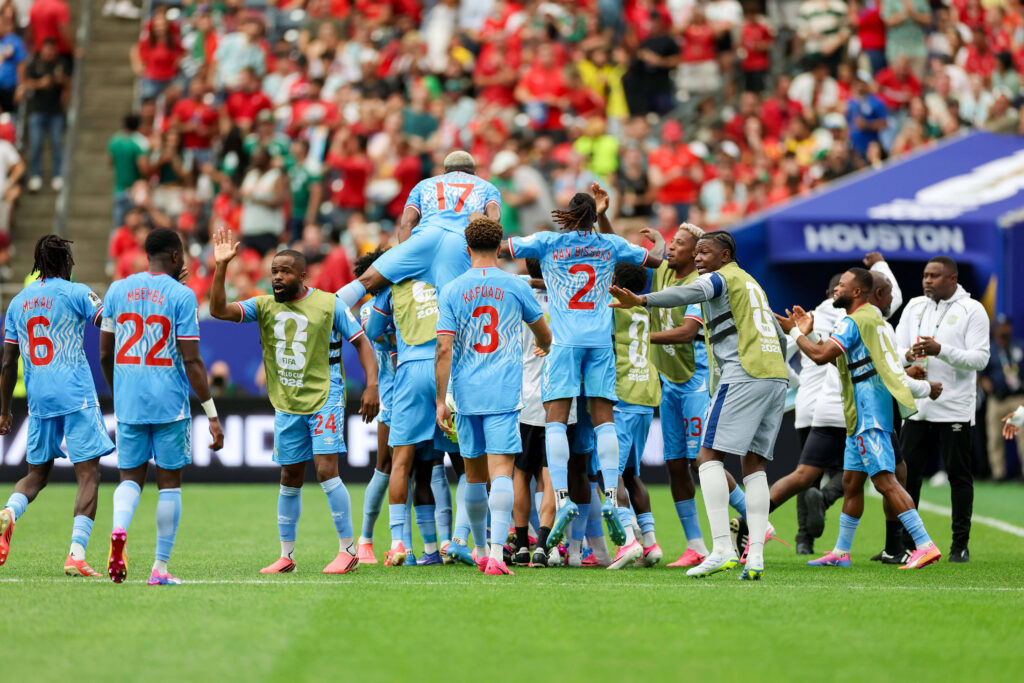
Fresh revelations surrounding Nigeria’s failed bid to qualify for the 2026 FIFA World Cup have reopened one of the most painful chapters in the Super Eagles’ recent history, with an investigation by The New York Times reporting that FIFA officials knew Democratic Republic of Congo had fielded an ineligible player during the qualifying campaign.
According to the investigation, FIFA’s legal officials determined that DR Congo goalkeeper Lionel Mpasi had not completed the required process to change his international affiliation from France, where he had represented the country at youth level.
Despite the finding, FIFA allowed Mpasi to continue playing for DR Congo, including in the decisive African play-off final against Nigeria in November 2025. DR Congo went on to win the match on penalties and subsequently defeated Jamaica to secure a place at the 2026 World Cup.
The development has now cast fresh attention on Nigeria’s complaint against DR Congo and the circumstances surrounding the Super Eagles’ elimination.
How Nigeria lost its World Cup route
Nigeria’s World Cup hopes ended in November 2025 after the Super Eagles drew 1-1 with DR Congo in regulation and extra time before losing the decisive penalty shootout.
The defeat meant Nigeria missed the 2026 World Cup and also lost the opportunity to represent Africa in the intercontinental play-off.
The Nigeria Football Federation subsequently lodged a complaint with FIFA, challenging the eligibility of several DR Congo players. The federation had particularly raised questions about players with foreign backgrounds and their eligibility to represent the Congolese national team.
FIFA eventually rejected Nigeria’s complaint on procedural grounds. The governing body said its disciplinary committee had examined the case and declared the complaint inadmissible, adding that the decision became final after no valid appeal was lodged within the applicable period.
However, the latest investigation claims FIFA’s own legal officials later uncovered a problem with Mpasi’s eligibility.
Documents reviewed by The New York Times reportedly showed that FIFA considered several possible courses of action, including awarding Nigeria the disputed match, imposing a fine on DR Congo, replacing DR Congo with Nigeria in the play-off against Jamaica or taking no action because of the timing of Nigeria’s complaint.
The revelation is significant because Nigeria had already lost its direct route to the World Cup when the eligibility issue was being considered.
FIFA’s previous decisions raise questions
The report has also drawn attention to FIFA’s handling of previous eligibility cases.
In earlier World Cup qualifying cases, FIFA imposed sporting sanctions after teams were found to have fielded ineligible players. The latest revelations have therefore raised questions about why the DR Congo case was handled differently.
The New York Times reported that a FIFA legal official not involved in the case authenticated documents relating to the investigation, while FIFA has not disputed the core finding that its committees examined the eligibility issue.
The governing body, however, has rejected any suggestion that President Gianni Infantino interfered in the matter, stressing that FIFA’s judicial bodies operate independently and make decisions based on applicable regulations and the facts presented to them.
Infantino, Congo football leadership link
The investigation has also brought renewed attention to the relationship between Infantino and Véron Mosengo-Omba, who was an ally of the FIFA president and was involved in the leadership race for the Congolese football federation around the time the eligibility issue was being reviewed.
Mosengo-Omba later emerged as the sole candidate and was elected president of the Congolese federation after other contenders withdrew or were disqualified under revised eligibility rules.
Former FIFA official Prince Zelkifli Rahman Ngoufonja, popularly known as Prince Zul, told The New York Times that removing DR Congo from the World Cup could have affected Mosengo-Omba’s prospects.
Mosengo-Omba, however, said he was unaware of FIFA’s findings regarding Mpasi, while FIFA has maintained that Infantino had no role in the decision.
A painful question for Nigeria
For Nigerian football, the revelations have revived memories of a defeat that already had major consequences.
The Super Eagles’ failure to qualify for the 2026 World Cup contributed to significant changes within the Nigerian Football Federation, with the federation’s leadership eventually resigning.
Former NFF president Ibrahim Musa Gusau said he was informed that Nigeria’s complaint had been rejected for technical reasons but was not told that FIFA officials had identified an eligibility problem involving Mpasi.
Gusau has since called for an investigation into the handling of the case.
The latest revelations do not, by themselves, change the result of the Nigeria-DR Congo play-off or automatically give Nigeria a place at the World Cup. But they have reopened questions about whether the eligibility complaint was handled consistently and whether the Super Eagles could have had another opportunity to qualify had FIFA acted differently.
For Nigeria, the issue is therefore no longer simply about a penalty shootout defeat. It has become a renewed debate over eligibility rules, due process and the way FIFA handled a complaint that had potentially enormous consequences for the country’s World Cup hopes.