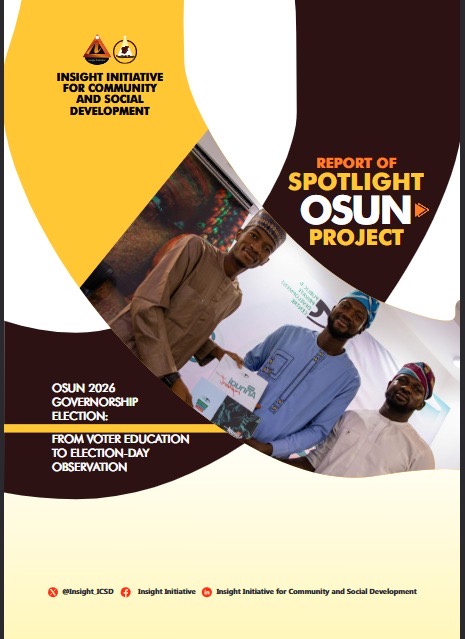
From Citizen Awareness to Election-Day Observation and the Work of Keeping the Spotlight on Governance
When we look back at the journey of SPOTLIGHT OSUN – For Transparent Governance, what stands out is not only the number of activities implemented, but the deliberate effort to take civic engagement beyond the traditional confines of election campaigns.
Launched on June 8, 2026, by the Insight Initiative for Community and Social Development (IICSD), SPOTLIGHT OSUN was conceived as a three-month civic engagement project designed to promote informed citizenship, transparent governance, peaceful elections, credible information and post-election accountability around the August 15 Osun State governorship election. From the outset, our objective was clear: to put citizens at the centre of the electoral conversation and ensure that the people had the information, platforms and opportunities to participate meaningfully in the democratic process.
What followed was an intensive period of research, public engagement, stakeholder consultations, voter education, fact-checking, media engagement, technology deployment and election observation. In many respects, SPOTLIGHT OSUN became a journey from “Know Your Power, Know Your Facts”, through “See It, Trace It, Vote It”, to “Your Vote, Our Watch”.
Starting With the People
The first lesson from the project was that meaningful electoral participation cannot be achieved simply by telling people to vote. Citizens need to understand why their vote matters, how elections work, what their rights are and how they can hold political leaders accountable beyond election day.
This informed the first phase of SPOTLIGHT OSUN, tagged “Know Your Power, Know Your Facts.” We began by taking civic education and conversations about governance to communities and important institutions across Osun.
Our engagements included consultations with traditional rulers, the Osun State Muslim Community (OSMC), media executives and journalists, civil society organisations, political actors, security stakeholders, INEC and other relevant actors. The project also promoted the Osun Voter’s Compact and Vote Not Fight Reloaded, aimed at encouraging peaceful participation and discouraging electoral violence.
One of the memorable engagements was our meeting with traditional rulers, where we reached 36 traditional rulers, including the Olojudo of Ido-Osun, Oba Olayinka Ishola Jokotola III; the Alawo of Awo, Oba Abdulrasaq Taiwo Adegboye, Abioye III; and the Alara of Ara, Oba (Dr.) Olubayo Windapo, Abidogun I.
We also engaged the leadership of the Osun State Muslim Community, led by Alhaji Mustafa Oluwuyi, and visited media stakeholders, including the management of Afinju 90.7FM, Osogbo, led by its Chief Executive Officer, Adedayo Oderinu.
These engagements reinforced our understanding that traditional and religious institutions remain important channels for reaching communities, while the media remains indispensable to the dissemination of credible information and the fight against misinformation.
Taking Citizens’ Priorities to Political Actors
One of the strongest components of the project was our effort to ensure that citizens did not merely listen to politicians but had an opportunity to put their own priorities before them.
IICSD, in partnership with the Public and Private Development Centre (PPDC) and AdvoKC Foundation, participated in the development and presentation of the Osun Youth and Women Manifesto, a product of research and consultation focusing on what young people and women want from government.
The manifesto addressed issues including employment, youth inclusion, sports, infrastructure, electricity, water supply and community development.
We took the document directly to political actors. Among the key engagements was the meeting with the ADC governorship candidate, Dr Najeem Folasayo Salaam, who adopted the document and pledged to integrate its priorities into his agenda if elected. He also identified security and stable electricity as priorities and spoke against political violence and intimidation.
The document was subsequently presented to the APC campaign team of Asiwaju Munirudeen Bola Oyebamiji (AMBO) during an engagement with Osun youths, students and civil society stakeholders.
For us, these engagements represented an important principle: citizens should not be passive recipients of political promises. They must be able to tell political actors what matters to them.
The project therefore deliberately remained non-partisan. We engaged candidates and political actors not to endorse them, but to create space for citizens’ concerns to enter the political conversation and for voters to assess candidates on the basis of their programmes, competence and commitments.
Building Partnerships
SPOTLIGHT OSUN also demonstrated the importance of partnerships.
In the course of the project, IICSD worked with organisations including PPDC, AdvoKC Foundation and the International Press Centre (IPC), alongside other civil society, media and development partners.
A strategic meeting with PPDC in Abuja provided an opportunity to discuss deeper collaboration around electoral transparency, citizen engagement, misinformation management and accountability before, during and after the election.
The collaboration also strengthened our work under Fact-Check Osun Election, through which IICSD worked with IPC to improve the quality of electoral information available to citizens and the media.
The lesson was clear: an election of this scale cannot be adequately addressed by one organisation. Partnerships allowed us to combine expertise, networks, technology, media capacity and grassroots relationships.
Making the Electoral Act Understandable
Perhaps one of the most visible components of SPOTLIGHT OSUN was the 15-day “Inside the Electoral Act” voter education series, which ran from July 31 to August 14, one day before the election.
Anchored by IICSD Executive Director Jare Tiamiyu and produced by Temiloluwa Olubode, the series broke down complex electoral provisions into practical information that ordinary voters could understand.
The episodes covered the Electoral Act 2026, PVCs, voting procedures, voters’ rights and responsibilities, electoral offences and other important aspects of election-day processes. The programme also featured interviews with residents across Osun, allowing us to hear directly from citizens about their understanding of the electoral process and their preparedness for the election.
The response demonstrated the value of simple, accessible civic education. The series produced 15 episodes and achieved more than three million social media reach, according to the project summary.
Beyond the numbers, the conversations with residents gave us an opportunity to identify knowledge gaps and encourage citizens to vote peacefully, understand their rights and report electoral malpractice.
Fighting Misinformation With Facts
The information environment surrounding the election presented another major challenge.
Through Fact-Check Osun Election, we investigated political claims, election-related information and viral content capable of misleading voters or undermining confidence in the electoral process.
The project report records 22 fact-checks and two explanatory pieces produced under the initiative.
Fact-checking did not stop with pre-election claims. On election day itself, the team responded to emerging misinformation, including a viral photograph falsely presented as showing former United States President Donald Trump serving as an international observer at the Osun election. A fake-results publication by a national newspaper was also debunked.
These interventions demonstrated why local fact-checking capacity is essential. False information moves quickly, particularly during elections. The ability to identify, investigate and respond to such claims in real time can help protect voters and reduce unnecessary tension.
Technology as a Civic Tool
Technology was another important part of our strategy.
As part of our broader civic technology work, Amoye, the IICSD/OsunOpenLG AI-assisted chatbot, was upgraded to simplify access to election-related information. This allowed citizens to access electoral information through a more accessible digital platform.
The experience reinforced our belief that technology should not merely be used as a communication channel but as a civic tool—one capable of helping citizens understand government, elections, public institutions and their rights.
The Final Test: Election Day
Everything we had done before August 15 ultimately prepared us for the most demanding component of the project: election-day observation.
On August 15, IICSD participated in an Election Day Situation Room in partnership with PPDC and other civil society and development partners.
More than 300 trained observers were deployed across all 30 Local Government Areas of Osun State. The network provided a mechanism for receiving, verifying, documenting and escalating reports from polling units in real time.
The observation found that voting was largely peaceful across the areas monitored, with significant participation by youths, women, elderly voters and persons with disabilities.
But the exercise also showed why independent observation remains important.
Reports were received concerning vote trading and voter inducement, isolated violence, disruptions at some polling units, attacks or harassment involving a journalist, and BVAS challenges. BVAS problems were reported in parts of Irewole, Ifelodun, Boluwaduro, Osogbo, Irepodun, Ejigbo and Aiyedire LGAs, with several cases escalated to INEC and subsequently resolved.
The observer network also documented encouraging instances of elderly voters and persons with disabilities receiving assistance in areas including Odo Otin, Osogbo and Olorunda.
At midday, PPDC and its civil society partners issued a preliminary statement based on verified information from the Situation Room and observer network. More than 70 per cent of observed polling units had opened and commenced voting between 7:30 a.m. and 8:30 a.m., while voter participation was generally encouraging.
What the Journey Taught Us
Looking back, SPOTLIGHT OSUN was more than a collection of activities. It was an experiment in what sustained, locally driven civic engagement can achieve when education, technology, partnerships, media and citizen participation are brought together around a common objective.
The project reached people in communities, royal institutions, faith-based organisations, media houses, political platforms and polling units. We sat with traditional rulers. We spoke with religious leaders. We engaged journalists and media executives. We questioned political actors and presented citizens’ priorities to them. We spoke directly with voters. We worked with civil society partners. We deployed observers across all 30 LGAs. We monitored information and responded to misinformation.
And perhaps most importantly, we listened.
The experience also reminded us that electoral accountability cannot be a seasonal activity. The project identified persistent challenges around vote buying, voter inducement, misinformation, accessibility, electoral technology and the need for stronger voter education.
Beyond August 15
The end of the election does not mean the end of SPOTLIGHT OSUN’s philosophy.
If anything, the election has strengthened our conviction that citizen engagement must continue between elections, not only during them.
The next phase of this work must involve following up on campaign promises, tracking governance commitments, strengthening local fact-checking, continuing civic education and creating more opportunities for citizens to engage government at every level.
This is particularly important because the people whose voices we amplified during the election will continue to live with the consequences of governance long after the campaign posters have disappeared.
The Osun Youth and Women Manifesto should therefore remain a reference point for policy engagement. The lessons from Inside the Electoral Act should inform year-round voter education. The experience of Fact-Check Osun should contribute to a stronger local information ecosystem. The networks created through stakeholder engagement should continue to promote peace and accountability. And the Situation Room experience should inform future election observation and civic monitoring.
The Spotlight Stays On
For IICSD, the greatest achievement of SPOTLIGHT OSUN is not simply that we completed the activities planned on paper. It is that we were able to translate a project concept into a sustained presence across different layers of Osun’s civic and electoral space.
From June 8 to election day and beyond, we worked to ensure that citizens had facts, platforms and opportunities to participate.
The figures tell part of the story: 15 voter-education episodes reaching more than three million people; 22 fact-checks and two explanatory pieces; engagement with 36 traditional rulers; consultations with political candidates and campaign teams; engagement with INEC, OSMC, NURTW, CSOs and other stakeholders; and 303 observers deployed across all 30 LGAs.
But the deeper story is about people.
It is about the voter who understood a part of the Electoral Act for the first time.
The citizen who learned to question a viral claim before sharing it.
The young person who asked a political actor what his plans were for employment.
The traditional ruler who committed to promoting peaceful participation.
The voter who insisted on exercising the right to choose freely.
The observer who reported a problem from a polling unit.
And the institution that responded when that problem was escalated.
These are the building blocks of democracy.
SPOTLIGHT OSUN may have been designed around an election, but its real objective was always bigger than an election. It was about building citizens who know their power, know their facts and understand that their responsibility does not end after casting a ballot.
As we close this chapter, one message remains at the heart of the project:
The election may be over. The work of citizenship continues.
And at IICSD, the spotlight stays on.