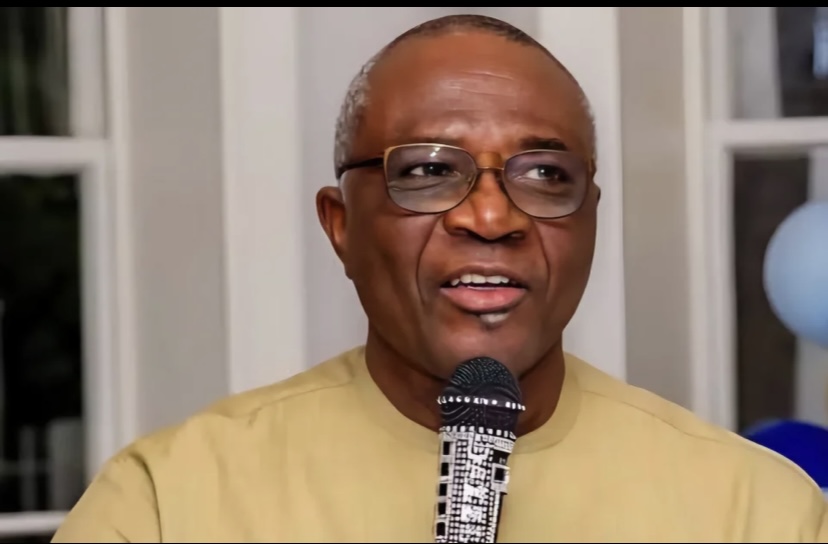
The Special Adviser to President Bola Tinubu on Information and Strategy, Bayo Onanuga, has accused sections of the Nigerian media of exaggerating the country’s security challenges, arguing that news reports often create the impression that Nigeria is entirely unsafe.
Speaking during an interview on Arise Television on Tuesday, Onanuga maintained that although security threats remain a serious concern, the situation should not be interpreted as evidence that the nation is under siege.
According to him, media coverage frequently portrays insecurity as though it has engulfed every part of the country.
“The problem is that the media in Nigeria, they’re even creating the problem. The way they’re reporting security is as if the entire country is consumed,” he said.
Onanuga noted that many Nigerians continue to travel safely across different parts of the country, citing instances of individuals undertaking long-distance road trips without encountering security incidents.
“Don’t let people threaten you that the entire country is under siege. It’s not. There are security breaches. There are major security breaches,” he stated.
The presidential aide acknowledged the persistence of kidnappings and violent attacks but suggested that many incidents occur during night journeys, despite repeated warnings from security agencies against travelling after dark.
“Any time I read about either a kidnap or an attack somewhere, sometimes I look at the time. I say, wow, it happened 8 p.m., it happened 9 p.m., sometimes 1 a.m. A long time ago, the police told people to stop travelling at night,” he said.
He further referenced a discussion with a government official who reportedly completed a lengthy road trip without incident, describing such experiences as evidence that movement across the country remains possible.
Onanuga made the remarks while responding to discussions on terror-related fatalities in Nigeria between 2015 and 2026.
During the programme, interviewers cited data compiled by Beacon Security and Intelligence Limited and Armed Conflict Location and Event Data Project, which reportedly showed a 4.6 per cent increase in deaths linked to groups such as ISWAP, bandits, IPOB, ESN and armed herders between 2015 and 2025.
The figures appeared to contradict President Bola Ahmed Tinubu’s recent assertion that insecurity-related fatalities had declined by 81 per cent.
In response, Onanuga defended the Federal Government’s statistics, insisting that the Presidency relies on information provided by the Office of the National Security Adviser.
“You can’t be so categorical about that. The data we’re offering is the data provided by the Office of National Security Adviser. That’s the data we use,” he said.
Questioning the reliability of alternative figures, he added: “Whoever has compiled this, where have you got it from?”
When informed that the data originated from internationally recognised organisations specialising in conflict tracking and security analysis, Onanuga maintained that government figures should not be dismissed.
“They may be wrong. The data we have is the data from the Office of National Security Adviser. You cannot say the data is wrong and only this one is right,” he said.
The exchange highlights ongoing debates over the measurement of insecurity in Nigeria and the differing interpretations of security data by government officials and independent monitoring organisations.