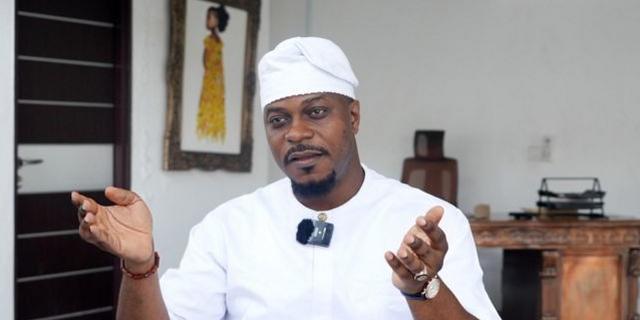
The Lagos State governorship candidate of the African Democratic Congress, Gbadebo Rhodes-Vivour, has said fluency in Yoruba should not be a requirement for preserving and protecting the indigenous culture of Lagos State.
Rhodes-Vivour made the clarification in a video shared on Monday, days after his response to a question on Yoruba culture and language at the Independence Day edition of The Platform sparked reactions.
At the October 1 event, an attendee had asked the ADC candidate how he would preserve Yoruba culture, tradition and language in Lagos if elected governor. Some members of the audience subsequently urged him to respond in Yoruba after he began answering in English.
The incident triggered debate on social media, with some critics questioning his connection to the Yoruba identity of Lagos based on his difficulty speaking the language fluently.
Responding to the controversy, Rhodes-Vivour said he had never disputed the Yoruba identity of Lagos, stressing that indigenous groups such as the Aworis and Eguns played important roles in the development of the state.
“I have consistently said the opposite. Lagos is Yoruba land, with indigenous people like the Aworis and the Eguns contributing to creating the welcoming cosmopolitan Lagos that we know and love,” he said.
The ADC candidate explained that his challenge was with fluency rather than an unwillingness to speak Yoruba, adding that he often thinks in English before expressing himself in other languages.
“I said this as it relates to fluency. A lot of us process our thoughts in English. I do. I think in English and then I translate to other languages. As you can see from what happened at The Platform, my Yoruba has a way to go and we are making efforts,” he said.
Rhodes-Vivour argued that protecting Lagos’ cultural heritage ultimately depends more on government policies and commitment than on the governor’s ability to speak perfect Yoruba.
“My business is governance. I don’t have to speak perfect Yoruba to preserve and protect the indigenous culture of Lagos,” he said.
He said his vision was for a Lagos where its history and heritage would be preserved while people from different backgrounds would continue to live and contribute to the development of the state.
“A city where heritage is remembered, culture is respected, and people from different backgrounds build one future together,” he added.
Rhodes-Vivour also addressed criticism surrounding his viral “Afonja” meme featuring President Bola Tinubu.
He explained that the reference was directed at what he described as the President’s perceived silence over the killings of Yoruba people and what he considered the prioritisation of political alliances.
“It’s not an insult or a slur on the entire Yoruba race. Bola Ahmed Tinubu is not the avatar for the entire Yoruba race,” he said.
The controversy comes as political activities gradually intensify ahead of the 2027 governorship election in Lagos, where issues of identity, governance, infrastructure and the state’s rapidly growing population are expected to feature prominently in political campaigns.
Rhodes-Vivour used the opportunity to shift attention to what he described as some of the major challenges confronting Lagos residents, including housing, traffic congestion, flooding, waste management, poor roads and alleged corruption.
He criticised the state government over its handling of these issues, particularly the high cost of housing and persistent traffic problems.
“Unfortunately, their candidate is responsible for the stench of Lagos, the lack of affordable housing, traffic, the dirty streets, badly constructed roads, poor state of our hostels and schools, and the massive corruption that has become endemic in the management of Lagos State finances,” he said.
He also criticised comments attributed to the government on traffic and housing, arguing that residents should not be made to accept difficult living conditions as normal.
Looking ahead to the 2027 election, Rhodes-Vivour outlined some of the policies he said an ADC-led administration would pursue if elected.
He promised to prioritise affordable housing, transportation, flood control and waste management, including the delivery of 100,000 affordable housing units.
“Our Lagos is a Lagos that will work for you. We’ll focus on delivering affordable housing to 100,000 units. We’ll build out the rail system in two years,” he said.
Rhodes-Vivour also promised to tackle flooding and decentralise waste management by giving local governments a greater role in keeping their communities clean.
“We’ll tackle the incessant flooding in Lagos. We’ll build out the waste-to-wealth and waste-energy value chain by decentralising the waste management system and empowering local governments to actively participate in keeping Lagos clean,” he said.
He further pledged to tackle alleged racketeering in the waste management sector while creating alternative opportunities for young people involved in street activities.
“We’ll get rid of the racketeering and corruption that is endemic in the waste management system, and lastly, we’ll create a new pathway to a productive life for the many young men that currently intimidate and harass productive members of our society,” Rhodes-Vivour said.