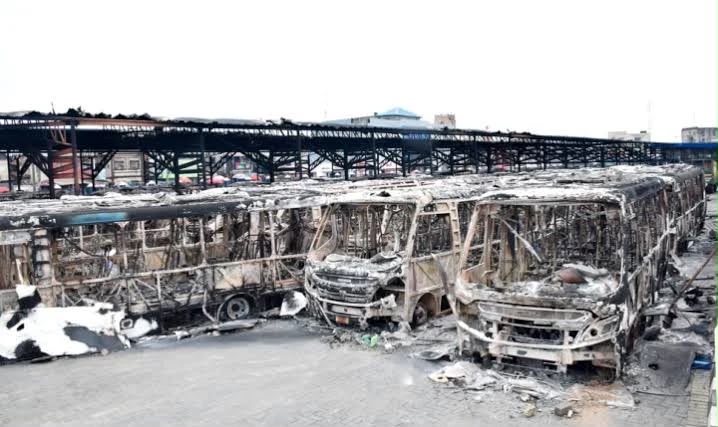
The Lagos State Government has explained why it has yet to replace all Bus Rapid Transit (BRT) buses destroyed during the #EndSARS protests, citing a sharp increase in the cost of acquiring new buses.
The Deputy Governor of Lagos State, Obafemi Hamzat, disclosed this during a question-and-answer session with Nigeria Info FM on Thursday.
Hamzat said the buses were initially purchased for about N80 million each but now cost approximately N280 million per unit, making it difficult for the state government to replace the vehicles.
“During #EndSARS, if you recall, 200 of those buses were burnt. We bought those buses at that time for 80 million per bus. Now, it’s about 280 million per one,” Hamzat said.
He explained that the state had also anticipated the need to withdraw some older buses from circulation after seven or eight years, making the failure to replace the burnt vehicles a major challenge for the public transportation system.
According to him, the inability to replace all the affected buses has contributed to the shortage currently being experienced by commuters across the state.
“Unfortunately, you know, we’ve not been able to replace all the 200, and that’s what we are seeing today,” he said.
However, Hamzat’s claim that 200 BRT buses were destroyed during the #EndSARS unrest differs from figures previously released by the Lagos State Government.
In April 2021, the then Commissioner for Information and Strategy, Gbenga Omotoso, said 80 BRT vehicles were destroyed during the violence.
According to the breakdown released at the time, 23 large BRT buses were burnt in the Ojodu area, while 57 medium-sized buses were destroyed at Oyingbo, bringing the total number of affected BRT vehicles to 80.
The destruction occurred during the violence that followed the #EndSARS protests in October 2020, which began as demonstrations against police brutality and calls for the scrapping of the Special Anti-Robbery Squad (SARS).
The unrest later escalated into widespread violence and destruction across parts of Lagos, with the Oyingbo BRT terminal among the facilities attacked.
Hamzat said the state government was now looking towards increased private-sector participation as part of efforts to address the shortage of buses and improve public transportation.
He said private operators could acquire and deploy buses more quickly, while the government could subsidise fares to make transportation more affordable for residents.
“But thankfully, a lot of private sector people are also bringing in buses to make sure, we must get it to a stage where private people actually bring in buses and then we subsidise the cost for people because private will be able to manage it better than us,” he said.
The deputy governor also argued that government should not necessarily be directly involved in managing buses, saying private operators could respond more quickly to transportation demands.
“Government should not be in the business of managing buses and the rest because it becomes cumbersome before you get approval and all those things. But if it’s private, they are able to do it. They are nimble, they are faster,” Hamzat said.
He added that the state was expanding other transportation options, including ferry services, while efforts were also being made to improve the rail system.
“We are bringing in ferries. Our train is working better. So, by the time we put all this together, then, you know, transportation will be better for everybody in Lagos,” Hamzat said.