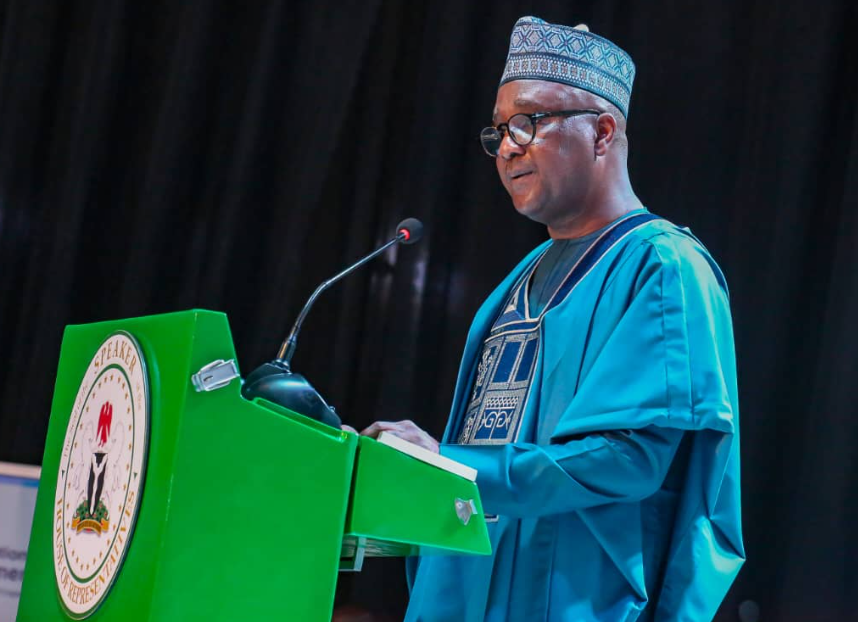
The Speaker of the House of Representatives, Tajudeen Abbas, has congratulated President Bola Tinubu on the third anniversary of his administration, describing the President’s economic and governance reforms as courageous decisions aimed at securing long-term national stability and growth.
Abbas made the remarks in a statement issued on Friday by his Special Adviser on Media and Publicity, Musa Krishi.
According to the Speaker, Tinubu inherited an economy facing serious structural and fiscal challenges but chose to implement difficult reforms rather than adopt politically convenient measures.
“President Tinubu inherited a country on life support. A country on crutches. A country bedevilled by subsidy distortions, exchange rate instability, declining revenues, weakened investor confidence, oil theft, worsening insecurity and an economy weighed down by years of postponed decisions,” Abbas stated.
He said the administration’s policies under the Renewed Hope Agenda were already producing visible results across key sectors of the economy.
“The politically convenient option would have been to continue postponing reality. But President Tinubu chose reform. He chose reconstruction. He chose long-term national stability over temporary political comfort,” Abbas added.
The Speaker highlighted improvements in economic indicators, noting that Nigeria’s Gross Domestic Product growth reportedly increased from 2.74 per cent in 2023 to 3.87 per cent in 2025, while global financial institutions projected further growth in 2026.
He also said the country’s external reserves improved significantly, rising from about $4bn in 2023 to over $34bn in net reserves by the end of 2025, with gross reserves exceeding $50bn.
On public finance, Abbas stated that allocations from the Federation Account Allocation Committee rose substantially following the removal of fuel subsidy and foreign exchange reforms.
“By 2025, cumulative allocations had crossed ₦22tn, with several months exceeding the historic ₦2tn mark for the first time in Nigeria’s history,” he said.
The Speaker further noted that foreign investment inflows increased from $654.65m in the third quarter of 2023 to $5.64bn in the first quarter of 2025, attributing the rise to growing investor confidence in the economy.
According to him, the increased investments were expected to boost industrial growth, create jobs and support local businesses.
Abbas also pointed to ongoing infrastructure projects, including the Lagos-Calabar Coastal Highway, the Sokoto-Badagry Super Highway and the Abuja-Kaduna-Kano Highway, as evidence of the administration’s commitment to expanding economic opportunities across the country.
He said investments in rail modernisation and road infrastructure were critical to opening up economic corridors nationwide.
On security, Abbas said allocations to defence and security rose from about ₦2.98tn in 2023 to over ₦4.91tn in the 2026 budget.
“Operations against terrorism, banditry, kidnapping, oil theft and organised crime have intensified nationwide,” he stated.
The Speaker also said crude oil production improved under the Tinubu administration, increasing from an average of 1.44 million barrels per day in 2023 to between 1.75 million and 1.84 million barrels per day.
In the education sector, Abbas disclosed that more than 1.3 million students had benefited from the Nigerian Education Loan Fund, with over ₦242bn disbursed to tertiary institution students across the country.
He further cited interventions in housing, manufacturing, industrial development and the digital economy as part of government efforts to stimulate growth and improve living standards.
While acknowledging ongoing economic and security challenges, Abbas maintained that the administration remained focused on implementing long-term solutions.
He argued that continuity beyond 2027 would allow the government to consolidate ongoing reforms and complete key projects.
“It is strategically expedient for Nigerians to renew President Tinubu’s mandate in 2027 to enable the completion of the policies, programmes and projects of his administration,” he said.
Tinubu assumed office on May 29, 2023, and introduced major economic reforms shortly after inauguration, including the removal of fuel subsidy and the unification of the foreign exchange market.
Although the administration insists the measures are necessary to stabilise the economy, the reforms have also triggered rising inflation and increased living costs, drawing criticism from opposition parties, labour unions and civil society groups.
Despite the criticism, supporters of the administration argue that the reforms are beginning to yield positive economic and fiscal outcomes that could benefit the country in the long term.
Abbas reaffirmed the commitment of the 10th House of Representatives to supporting policies and legislation aimed at promoting national development and improving the welfare of Nigerians.