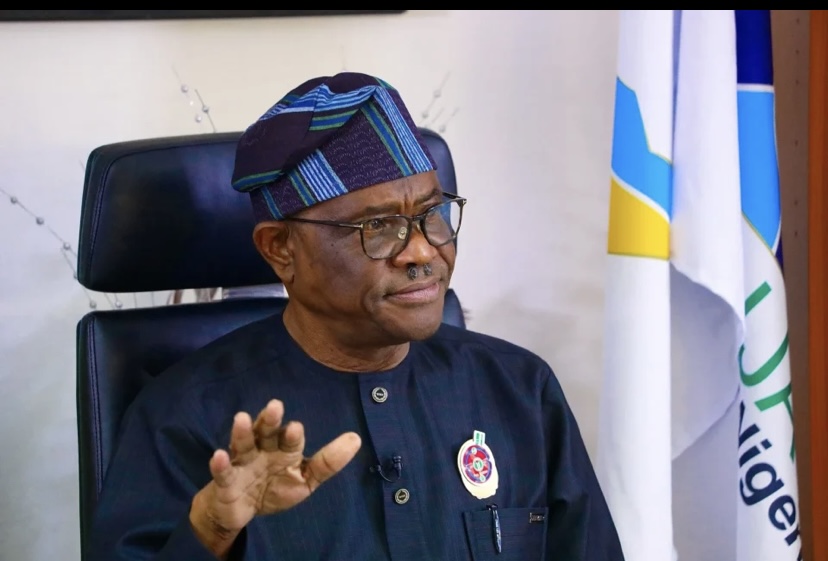
The Minister of the Federal Capital Territory, Nyesom Wike, has admitted that he worked with members of the All Progressives Congress (APC) to defeat his own party, the Peoples Democratic Party (PDP), in the 2024 Edo State governorship election, insisting that he has no regrets about his role.
Wike said the alliance was deliberately formed to prevent former Edo State Governor Godwin Obaseki from determining his successor, despite the PDP’s choice of Asue Ighodalo as its candidate.
The minister made the revelation on Monday in Abuja during a stakeholders’ meeting of the Rainbow Coalition, a cross-party political platform associated with efforts to mobilise support for President Bola Tinubu’s re-election bid in 2027.
Reflecting on the election, Wike said the collaboration between some PDP members and APC stakeholders contributed to the victory of the APC candidate, Monday Okpebholo, who is now the governor of Edo State.
“Let me say this for people to know. A lot of people deny obvious facts. In the last election that took place in Edo State, the victory was as a result of the coalition between the legacy of PDP and the APC,” he said.
Wike added that he personally supported the arrangement because he wanted to prevent Obaseki from retaining political influence through the emergence of his preferred successor.
“We had to work together to make sure that the former governor, Governor Obaseki, did not produce his successor. And that is the truth. I was behind it, and I don’t have any regrets about it,” the minister stated.
The September 21, 2024 governorship election saw Okpebholo emerge victorious with 291,667 votes, defeating Ighodalo, who polled 247,274 votes. Labour Party candidate Olumide Akpata finished third with 22,763 votes, according to results declared by the Independent National Electoral Commission.
Wike maintained that his opposition to Ighodalo was not based on the candidate’s qualifications. He described the PDP candidate as a good choice but argued that supporting him would have helped Obaseki maintain his political influence beyond his tenure.
The minister disclosed that Ighodalo had visited him several times to seek his support but said he refused because of his opposition to the former governor’s succession plan.
“He came to my house more than three times. I said, listen, you’re a good candidate. But for this election, I’m sorry,” Wike recalled.
He explained that he viewed the contest as a political struggle against Obaseki rather than simply a competition between candidates of different parties.
Wike’s role in Okpebholo’s emergence
Wike’s latest comments have brought renewed attention to the political alliances that shaped the Edo governorship election and the internal divisions within the PDP ahead of the poll.
Although Wike remained a PDP member, his opposition to Obaseki’s preferred successor placed him on the same side as APC figures seeking to end the outgoing governor’s political influence in the state.
He also credited the role of former Edo State Governor and serving senator, Adams Oshiomhole, in the political arrangement, arguing that the collaboration helped secure Okpebholo’s victory.
Wike used the experience to challenge the suggestion that political coalitions are absent from Nigeria’s electoral system, arguing that informal alliances between politicians across party lines have long influenced election outcomes.
His position reflects a recurring feature of Nigerian politics, where personal relationships, disagreements over party leadership and calculations about political succession can sometimes outweigh formal party affiliations.
Rainbow Coalition and Tinubu’s 2027 ambition
The minister’s remarks also come amid discussions surrounding the Rainbow Coalition, which seeks to bring politicians from different parties together to support Tinubu’s re-election in 2027 without necessarily requiring them to abandon their existing political affiliations.
Wike has maintained that the platform is focused on the presidential election and operates separately from the APC’s formal party structure.
However, the arrangement has generated debate among political stakeholders, with some APC figures expressing concerns that cross-party alliances could affect the party’s internal organisation and its candidates in the forthcoming elections.
Wike, who continues to belong to the PDP while serving in Tinubu’s APC-led Federal Government, has repeatedly taken positions that put him at odds with sections of his party, particularly over its direction and electoral strategy.
At Monday’s meeting, he also declared himself coordinator of Tinubu’s re-election campaign in the Federal Capital Territory and Rivers State.
Participants drawn from the PDP and APC reportedly agreed to work together to support Tinubu’s second-term bid and back APC candidates for senatorial and House of Representatives seats in the FCT.
Wike’s admission about the Edo election offers further insight into the political calculations behind Okpebholo’s emergence and highlights how alliances across party lines could again shape Nigeria’s political landscape ahead of the 2027 general elections.